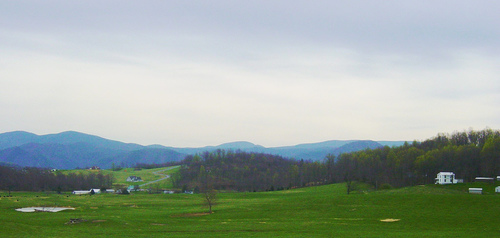
Southland

Photo by Martin LeBar - Flickr

I grew up in a tiny town at the edge of North Carolina and Tennessee, in the foothills of Virginia’s Appalachian Mountain chain. It’s always been a special place to me because half of my family history is there, buried in the rich, generous soil that surrounds the house where my mother still lives. When I was little, my explorations were boundaryless.  My best friend, Neal, and I wandered through stands of trees that led to glades so lush I imagined fairies or dwarves (or both!) had just been there; my sister and I dug for arrow heads – and found them – down by the family dairy barn.

Over the years, and with more sentimentality than I’d like to admit, I’ve written extensively about my home town. In college, I wrote a paper about it entitled “Boomtown”; it took on a life of its own for a time, absorbing all my available brain space and creative capacity. I kept working on it even after I submitted it to my professor because I cared so deeply about its integrity, and because I knew there was no way to say what I wanted to say about a place so set apart, a place so profoundly, indescribably my own.

When my roommates began asking about Boomtown as though it were a family member, or a pet, I knew it was time to let it go. But the effort put forth for that project and the subjects that surfaced because of it were like phosphorescence on a beach in cloud cover: tiny strobes filled with something pulsating and alive, something I wanted to touch.

After Boomtown, I knew two things: 1) That there was nothing like writing that gave me such passion or focus, and 2) That writing about the South was my gig.

People, especially educated people, give the South a hard time. We Southerners have earned a good measure of our infamy; we have behaved badly, acted ignorantly, upheld sorry rules in sorry times. We have shown poor judgment, kept to our narrow ways and spurned inclusion.

But most of us have progressed. And many of us are quite well educated, thank you. And in the midst of that overall advancement, I like to think that we have begun to till fruit-bearing soil again; that our strongest traits – the gracious, big-hearted, hot-blooded, come-hell-or-high-water types – have taken on new life.

We carry with us a stalwart pride in something akin to what I can only call a cultural landscape. This landscape goes deeper than grits; beyond silver-tongued Southern socialites; away from harsh, backward, low-down redneck banter. The depth and texture of it is born of strife, enriched and informed by a complex history of brokenness and fierce independence.

There is a great nonprofit here in Atlanta called the ArtReach Foundation (www.artreachfoundation.org).  It was founded by a woman named Susan Anderson, a passionate supporter of art therapy (“art” here being an umbrella for music, dance, writing, etc.).  In 2000, she and a team of art therapists helped a community in Bosnia begin to heal from the violence witnessed there. Since then, ArtReach has gone to Phuket and the Gulf Coast, creating beauty and signs of life in the wake of total destruction. 

The South, too, has worked to recover from its history by way of art in all its forms.  I know its music best, and it is music filled with life.  From spirituals to bluegrass, the voices and fiddles from the Southland tell stories both funny and tragic, exchanging historic lodestones for levity and compassion. 

As a writer, I approach this cultural landscape with lessons taken from what I know and what I grew up with. I consider my personal history, the people of my hometown, the trends its farmland bucks, and even the South as it will one day be – as a roughed-up plain of dirt spiked with arrowheads.

I must tread lightly here. I must dig. I must uncover. I must separate the bits of rock and turned-up roots from the flint, rough-hewn and ready for battle. I must seek the past and all its meanings with the careful, patient manner of a child who knows that beneath an ordinary pile of dry, fallow soil could be a treasure.

Work

A story about James Joyce:

A friend came to visit him one day and found Joyce sprawled across his writing desk in a posture of utter despair. “James, what’s wrong?” the friend asked. “Is it the work?”

Joyce indicated assent without even raising his head to look at the friend. Of course it was the work; isn’t it always?

“How many words did you get today?” the friend pursued.

Joyce (still in despair, still sprawled facedown on his desk): “Seven.”

“Seven? But James … that’s good, at least for you!”

“Yes,” Joyce said, finally looking up. “I suppose it is … but I don’t know what order they go in!”

– From Stephen King’s On Writing

A Michael Bittner Pic - from Flickr

Writing is hard.

This is something you won’t often hear from those of us who spend our days stringing words together, but it’s true, and there are a lot of books filled with writing advice to prove it.

Stephen King’s On Writing is as entertaining as it is illuminating. Like many other well-known writers’ handbooks (Anne Lamott’s Bird by Bird springs to mind here, too), King’s work of prescriptive genius is a combination of sage advice and memoir.

I approached On Writing with some trepidation. For one, I don’t write fiction. Specifically, I don’t write – or even really read – horror stories (they get too much in my head). But I admire Stephen King for his daring, and for his commitment to truth, and for the ways his wacky ideas fall so gracefully on the page. He is a master of storytelling.

This last fact proved to be no less true in On Writing than it was in It, or Carrie or The Shining. Even readers with little interest in learning how to write would enjoy King’s savvy rendering of writing as a tale worth telling. His love of language springs up amid the antics of his bizarre childhood (fueled by his bizarre imagination) and the drama of his alcoholism and recovery. Throughout, King writes of a dogged, joyful, no-B.S. commitment to his work that is, at once, clarifying, fear-inducing and inspiring.

A few words of Kingian wisdom:

Life isn’t a support system for art. It’s the other way around. (p. 101)

You can approach the act of writing with nervousness, excitement, hopefulness, or even despair – the sense that you can never completely put on the page what’s in your mind and heart. You can come to the act with your fists clenched and your eyes narrowed, ready to kick ass and take down names. You can come to it because you want a girl to marry you or because you want to change the world. Come to it any way but lightly. (106)

Stories are relics, part of an undiscovered pre-existing world. The writer’s job is to use the tools in his or her toolbox to get as much of each one out of the ground intact as possible. (164)

Talent renders the whole idea of rehearsal meaningless; when you find something at which you are talented, you do it (whatever it is) until your fingers bleed or your eyes are ready to fall out of your head. Even when no one is listening (or reading, or watching), every outing is a bravura performance, because you as the creator are happy. Perhaps even ecstatic. That goes for reading and writing as well as for playing a musical instrument, hitting a baseball, or running the four-forty. If there’s no joy in it, it’s just no good. It’s best to go on to some other area, where the deposits of talent may be richer and the fun quotient higher. (150)

Pig

**I apologize in advance to the vegetarians who may read this. I love animals (and veggies), too. Also, I’ll be more consistent with my posts now. I’ve been out of town a good bit.**

Allison Family Farm

When I found out my father had died, I was standing in my kitchen. We were having friends over for dinner that evening – two girls and a guy who have kept Ivy for us so often that she knows their names, and starts jumping for joy when we say them.

I was cooking pork tenderloin. The kitchen was hot; the oven on, at 500 degrees.

The last conversation I ever had with my dad was actually about how to cook the meat – more specifically, how long to cook it, and what color it should be when it was done. It was a quick conversation, memorable now only because of its finality, and because of the odd presence of pork tenderloin at both occasions … as though the pig somehow marked the beginning and the end of a small, curious circle.

My dad was a meat man. In fact, he loved all sorts of food. But, as a farmer, he prided himself on knowing all animal parts and their corresponding names – that a “pork butt,” for example, is actually a part of the pig’s shoulder – and knowing how to cook them.

When Andrew and I got married, my parents gave me the Joy of Cooking. I can remember my dad turning with interest to the pages diagramming cow and pig parts. He was almost gleeful – surprising in someone as stoic as my dad – and then serious, admonishing me to study the diagrams, to know not just what to do with my meat, but to know its origins, too. He would have liked Michael Pollan’s Omnivore’s Dilemma, had he the chance to read it.

I thought of this memory today because we’re having friends to dinner tomorrow night, and, as usual, I’m thinking of fixing pork tenderloin.

Despite the shock and sadness I associate with that day in May, the heat in the kitchen, the steamy scent of crispy marinated pork coming out of the oven, I still gravitate towards entertaining with tenderloin. Now, I grill rather than roast it. The meat does better that way, and it saves me the trouble of remembering too much, or of willing some other disaster by way of taking the same steps as before.

But, I continue to cook pork tenderloin. I use the same marinade; consider Daddy’s advice each time I check to see if the meat is done. I do this partly for renewed connection with my dad, but mostly because he would have hated to stand between anyone and a slab of good meat.


Bookshelf

After a two-year hiatus from reading fiction, I’ve picked it up again.

While in grad school, I immersed myself in the writing of great nonfiction authors: Agee, McPhee, Kidder, etc. You name ’em, I at least tried to read ’em. I was undeterred from nonfiction even during holiday breaks, alternating between narrative journalism and memoir in an effort to learn as much as I possibly could while I had immediate access to nonfiction experts (my professors).

To be honest, I didn’t even know how much I missed my cozy novels. I was even a little reluctant to read fiction again. After all, it had been so long, and I tend to treat books – and by extension, genres – like friends. How in the world would we get reacquainted after so much time had gone by? Would it be awkward? Would I lose interest?

Perhaps, I thought, it might lessen the shock to begin with historical fiction, or a smattering of short stories.

Bookworm

But no. As soon as I read the first page of Claire Messud’s The Emperor’s Children, fiction and I were back in good graces. Reading about make-believe characters in a make-believe world reminded me of the delicious escape books can provide. It tucked in the driven, learning-oriented side of my brain, giving it permission to take some much-needed rest.

For once, I wasn’t analyzing the book’s structure as I read, or its author’s interviewing techniques. I was reading for pure enjoyment, having returned to a playground that allowed me to grasp for the monkey bars or clamber across the jungle gym instead of spending all my time building things – or fighting – in the sand box.

Not that we nonfiction writers can’t learn a lot from our fiction sisters. Claire Messud’s descriptions of her characters are priceless. She rounds them out with impressive zeal, making them tangible – describing them more tangibly, even, than many accomplished nonfiction writers portray their real-life subjects. She notes one character’s “resemblance to a baby seal,” and another’s “Nabokovian brow.” Brilliant.

Messud also captures every detail of her characters’ surroundings, knowing – in an almost eerie show of authorial intuition – just what we readers need to see, noting, for example, “a long, plump, pillowed sofa stretched the length of one wall,” at a dinner party. Better yet, she writes that “upon it four women were disposed like odalisques in a harem.”

Yum.

In celebration of my return to a multi-genred life, I’ve set up a “Bookshelf” here on my blog, where all you lovely people can see what I’ve been reading, and where you, too, can recommend great books from your own libraries.

Happy reading …

Prove It!

Recently, I had a conversation with a friend about the existence of God.  We never said it that way, as in: “Do you believe in God?” – but that’s what it was about.

We were discussing a recent research project in the news, from which scientists had discovered the part of the brain that collects memories, thereby explaining that eerie sensation of deja vu. In response, this friend – let’s just call him H – said he believed that science would eventually explain everything, and that all the myths and “hocus-pocus” we’d been taught by our parents would one day be laid to rest – proven, for once and for all, to be completely untrue.

He said that 95% of the members of the National Academy of Science are atheists, and that all the progressive, intellectual people he knows are moving that way, too – an all-out migration to the sensible world of unbelief. “People of faith should have to prove their positions,” he said, “the same way scientists have to prove hypotheses.”

This entire conversation I had with H totally depressed me. I haven’t been able to shake it. And not because I was suddenly moved to atheism, or because I wanted to damn anyone to hell, but because his own perspective was just as boxed in and immovable as those with whom he disagreed.

As a person of faith, I am constantly challenged to reconcile the world’s tangible and intangible inconsistencies.  Living in a culture no longer drawn to imagine and question the unknown would be like having a birthday surprise perpetually spoiled.  The opportunity to merge a progressive, thoughtful faith with science (or social responsibility, or any other secular point) is a gift. It is an impetus for forward thinking, expansion and enlightenment. It is an invitation to become more open-minded and all-encompassing than before, driving out mean and narrow preconceptions, lifting up a shout to the unknown with joy and trepidation – a salute to what we all know already: that we are not in control.

And while my faith might be strengthened by this grappling as another’s is challenged to the breaking point, how terrible to silence those conversations, to so limit the scope of the human spirit that it becomes something that can be read on a data chart.

I didn’t want to argue with H because I wasn’t in the mindset to respond thoughtfully.  He’d caught me off-guard, and our conversation wouldn’t have been productive.

But if I had responded, really responded, I would have turned to Annie Dillard, who wrote, “No; we have been as usual asking the wrong question. It does not matter a hoot what the mockingbird on the chimney is singing. The real and proper question is: Why is it beautiful? ”

How do you prove the existence of love? Or of mercy? Beyond the realm of science, what, exactly, can anyone prove?

When it comes to faith, my hope is for curiosity, for more probing with less vexation.  My hope is that we might have the bravery to sift through our world’s inconsistencies without shutting down; to wrestle with them, knowing we may never know the answers.

In time, with discernment, perhaps we can find ourselves on a place in the path that is marked less by fear than by wonder, with an ultimate respect for the unknown, and an appreciation for surprise.