Libraries Burning

A few years ago, after Andrew and I first got married, we quit our jobs and blew our savings on the trip of a lifetime. We had friends in Australia and New Zealand who had offered us a place to stay (rent-free) for a few months. Some other American friends had gone to South Africa on a similar savings-blowing trip. They introduced us to their South African friends, Garth and Bridget, who extended hospitality by way of their Cape Town home’s back wing, complete with kitchenette and private entrance.

South Africa was first on our four-month travel itinerary. While there, Garth & Bridget gave us an old maroon Honda Accord to drive; they invited us to join them for dinner almost every night of our month-long stay. They welcomed us as though we were long-lost family members, as if they had known about us from birth and were overjoyed to lay eyes on us at last. Theirs was a welcome that far surpassed any Southern graces I have ever known.

Yet, I arrived in South Africa full of distinctively American anxieties. I was somewhat fearful of contracting malaria, worried about the place’s fledgling democracy and unrest resulting from its 40% unemployment rate, nervous about the rampant cases of HIV and AIDs, the sort of stuff – rapes and racial tensions – I’d read about in J.M. Coetze’s Disgrace.

In reality, the country was no less complex than that which I had imagined (though it was less dangerous), but it was also significantly more beautiful – in people and geography – than I could have guessed. Andrew and I spent days walking around Cape Town, driving across mountain ranges, drinking great South African wine. When we mentioned we wanted to see other sides of S.A., Bridget, a nurse, introduced us to some friends who worked in a poor township’s orphanage; the babies there, all HIV-positive, crawled all over us, touching our faces, hungry for human warmth.

A friend who had spent many years in Tanzania once said of the continent: “Africa just gets in your bones,” and it does. When we left, I felt a piece of it had become a part of me.

Happily, when I enrolled in my MFA program, I met a young woman named Maggie Messitt. Maggie is an American narrative journalist based in a small town in South Africa; in addition to telling the stories of her South African neighbors, she has singlehandedly started a non-profit organization charged with the purpose of teaching young South African women how to tell their personal stories and their country’s stories. She calls the nonprofit “Amazwi,” which means “voices” in Zulu.
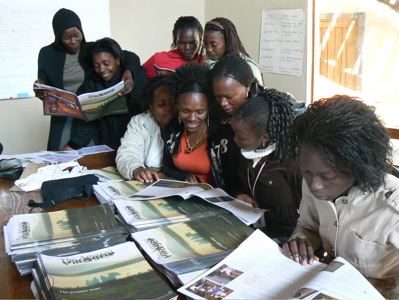
In any country, the effort to train and empower writers to record their lives and celebrate their native cultures could be regarded as a significant contribution to humankind. But add to this the staggering numbers of parents who die before their children are old enough to speak (due to AIDs), the nonexistence of public libraries, and the view of education as luxury, and the importance of the written word looms even larger.

Amadou Hampate Ba, a Malian writer and UNESCO representative, has said, “In Africa, when a man dies, it’s a library burning.” Thanks to Maggie Messitt and her dedicated staff of volunteers, this is slightly less true for South Africans. Their “libraries” databases are being preserved; through the Amazwi students’ narratives, the stories, languages, wisdom and experience of elders are finding a place in a quietly emerging canon of African literature.

This morning, I received an email update from Amazwi which included a poem written by one of the program’s students, Amukelani Mashele. Inspired by her Shangan heritage, she writes:


I work hard to leave footprints wherever I step

I never let challenges bring me down, so I dare anyone

I refuse to let someone judge me because,

Of Xitsonga that I speak or fair colour of my skin

Who can love me more than my own self? …


I am my own favourite person …


I am proud to support an organization that seeks to preserve national history while empowering young women to find their own voices, women who “work hard to leave footprints wherever [they] step”; women who maintain such self-respect that they can write, without twittering with insecurity, “I am my own favourite person.”


To learn more about Amazwi’s aims and programs, and its new literary magazine, A., please click on the Amazwi link on my blogroll or go to http://www.amazwi.org.

 

Becoming Greenific

Leg Warmers

Ok … time for another confession.

Even though I grew up on a farm, I have never been much of a tree hugger. In fact, I am so poorly versed in eco-friendly culture, I have no idea whether or not it is all right to call anyone a tree hugger or not, even when referring to one’s self. This may be the equivalent of using other offensive, outmoded words – and I would just have no idea.

It’s not that I don’t care about the earth, but that I grew up in a place where the land and its resources were so enmeshed with daily life that they required little extra thought. The farmers seemed to take good care of our pastures. (That was their job.) My dad led soil and water conservation for years and prided himself on his best practices. But I guess I always thought of these things in economic terms: you turn off the water while brushing your teeth because if you waste water, you waste money; same with the lights, and shutting the door behind you, and running the attic fan instead of the air conditioning. Conserving soil and water on the farm seemed also to reap financial rewards, although I do remember my dad mentioning something about erosion, and that it was bad.

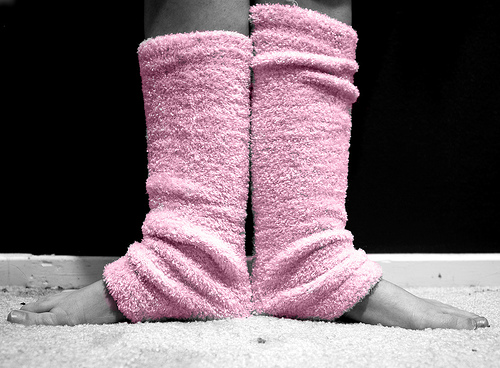
These days, conservationists are all the rage. Thanks to An Inconvenient Truth, Al Gore and global warming have become national celebrities. Going green has taken on similar characteristics to the ’80s fitness rage. Reducing one’s carbon footprint is the 2000’s equivalent of jazzercise (sans leg-warmers).

I found An Inconvenient Truth almost unbearable to watch – not because I don’t like ‘ol Al, but because what he was saying was so true, and so devastating, and so big. It was like discovering that someone or something you’d been taught was immortal had been diagnosed with terminal cancer. Suddenly (but not really suddenly), we are the ones in charge of saving everything – not just our own lawns, but everyone else’s, too.

I have never been one to jump on bandwagons. If the entire world is talking about a novel (think The DaVinci Code), for example, I’d really rather not read it. But this whole carbon footprint thing has gotten under my skin. It goes beyond the bandwagon. It must.

I, for one, am going to follow in the steps of my awesome, aforementioned sister-in-law, Jupe. Jupe is always thinking of new ways to be ecologically sound, and, for her birthday, I found these awesome bags called Envirosax. They are extra-strong, reusable grocery bags, which means that you save our landfills and recycling facilities from some plastic – and look stylish in the process. Jupe loved them so much, I’ve decided I should get some, too. (They come five in a set, and hold two plastic bags worth of groceries each!)

Still, I fear that our little smartcars and our recycling drives and our styrofoam avoidance will go the way of jazzercise. For heaven’s sake – if our current health trends are any indication, our air and water don’t stand a chance. According to the American Obesity Association, since 1976 (my birth year), our population’s percentage of overweight people has risen from 46% to 64%; the rate of national obesity has more than doubled, from 14.4% to 30.5%. So much for jazzercise. (Were the legwarmers to blame?)

I don’t have any answers on how to be greenific (remember, I’m a newbie – officially “green” – ha!), but I am committed to being my own little green person in whatever way I can. I hope, for the world, carbon reduction becomes as enmeshed with daily life as the rhythms of the land were for me growing up.

If anyone has helpful suggestions on how to become more ecofriendly – beyond buying Envirosax and conserving energy – please make a comment on my blog.

Sitting on Rocks

203232853_7deb0bb85d.jpg

When I was a sophomore in college, I called my mother and told her that all I really wanted to do with my life was sit on a rock and write poetry. She laughed (nervously) and mentioned something vague about a stable income.* And, my memory is foggy on this now, but I think my father’s reaction involved waving a rather high credit card bill in my face and talking, with some amusement, about how to live on a meager poet’s salary.

100_0099.jpg

*”Stable Income”

Yet, what did they expect? Throughout my adolescent summers, Mama sent me to academic sleep-away camps; and, when Daddy was in an especially whimsical mood, he would recite poetry at the dinner table (Donne’s “For Whom the Bell Tolls” was one of his favorites). Of all people, my sister – I assure you, the most practical of the two of us – majored in music, with a concentration in composition, and her music absolutely soared. Even if they’d all tried – which they didn’t, not really – they couldn’t have talked me out of poetry.

I loved – and love – poetry for its rhythm and vibrance, its uncanny ability to distill big truths with perfect precision. When I am at my most creative, my writing always goes back to poetry. I fall into this habit not because I am such a spectacular poet, but because that’s just how words naturally fall out of my head. I am drawn to peculiar images – big trees with crazy limbs, for example, or a semi-professional wrestler who also cuts women’s hair for a living – and I like to write around the images, attaching tiny themes to make them work in a poem. Sometimes this works well in nonfiction, too, but it has to be done sparingly. Otherwise, it appears as though the author is preening her feathers.

Obviously, I’ve strayed a bit from poetry, but I recently picked up Garrison Keillor’s edition of Good Poems, and it has inspired me again. There are so many good poems to read – poems that will make you laugh like crazy, or want to cry, or make you see something in an entirely new way – and there are so many great rocks out there in the world to sit on. Best of all, poems can be taken in in a sitting, like a shot of whiskey, and just like that, your whole day is different.

I write this so that all the poets in the world with high credit card bills can make their interest payments every month. In today’s literary marketplace, to make it as a poet means that you have probably met an angel who let you try on his halo. It is more difficult (and, oddly, less financially rewarding) than trying to make it in any other genre.

There are poems in this world for everyone – not just for people who like Shakespearean sonnets or Wallace Stevens’ abstractions. For the faint of heart, clicking on The Writer’s Almanac site on my Blogroll would be a great place to start. The poetry aisle – yes, there is such a thing – at a local bookstore is for the braver souls among you; because I have received such helpful feedback from you all on my own writing recently (thank you!), I’m confident you’re up for the challenge.

Happy reading!

A date! A date! A very important date!

526871574_0619de9d78.jpg

Today, I did for the first time what I hope will become a habit: I took myself on a date. I did this at the urging of The Artist’s Way, a book written by a woman named Julia Cameron for people (artists and non-artists) who want to augment their artistic lives. Cameron writes, “We forget that the imagination-at-play is at the heart of all good work … in order to have a real relationship with our creativity, we must take the time and care to cultivate it.” I took her at her word.

My date was to the High’s Annie Leibovitz exhibit, something I’d been meaning to get around to, but for which I had somehow never found the time. After a bright, breezy morning with Ivy and Andrew at the park, I showered quickly (who was there to impress, after all?), threw on my flip-flops and the most comfortable dress I own, and drove to Midtown.

Immediately, I savored the freedom of all this; the bold stroke of life on my own schedule. And it’s not that anyone in my life demands so much of me that it is a burden, but there is something deliciously indulgent about not having to apologize for parking a mile from the museum (in 90 degree weather) because you are too cheap to pay for parking, of walking through an art exhibit alone without feeling the need to respond to anyone’s opinion or curiosity, without worrying whether you’re spending too much time at each photo or not enough. Add to this the fact that I have been waist-deep in Khaled Hosseini’s A Thousand Splendid Suns, and the freedom tasted that much sweeter. (I am so moved by this book, I can’t even write about it yet. If you have not read it, you must.)

My experience with myself and Annie Leibovitz’s photographs (from both her personal and private collections) was filled with both a thrilling appreciation for beauty and startling emotion. I stayed there for two hours, looking for stories in every photo.

I became fixated on one photograph of Leibovitz’s parents on their 50th wedding anniversary, on another of a pool of blood beside a fallen bicycle in Sarejevo, and another of two circus performers: a woman was strapped to a massive red and white bullseye – on her face was a look of total boredom and resignation; a man stood in front of her and took aim with a dagger. I cried at the sight of Johnny Cash, June Carter and Roseanne Cash playing music on their front porch in Kentucky. I cried again when I came to Leibovitz’s photo of bloody footprints left from the massacre at a schoolhouse in Rwanda. Again, I cried at the photos preceding Susan Sontag’s death, and the death of Leibovitz’s father. Leibovitz captured each scene, each tiny moment, with curiosity, dignity, a raw and naked tenderness.

This afternoon, while standing in the High Museum, where everything is brilliantly white and crisp (its design reminds me of what it might be like to live inside an iPod), it struck me that all art – drama, visual art, music, writing, etc. – is connected by that which is alive in all of us. The spirit of great art is the thing that moves us from hope to despair and back again. It leans in to curiosity — not just to beauty and freedom, but also into ugliness and rage. Art is always looking for answers, retribution, a kind of hope that sees clearly the pain and unfairness of the world but continues to demand more of it.

After leaving Leibovitz, I wandered into the High’s museum store and was overcome with the urge to buy something beautiful. I recognized in this a desire to bottle my experience, to bring it home with me and put it on a shelf – as if a painted porcelain bowl or a coffee table book would somehow infuse my living and work space with a better sense of purpose, or some higher plain of artistry.

But the truth is that such things can only stretch so far. Eventually, I would flip through the $75 coffee table book out of moral obligation, would, at some point, pass the beautiful serving bowl and think, with disdain, that it needed dusting. I’m all about cherishing beautiful things, but then again, we have museums for a reason. They show us what to look for and help us to see. They silence the noise in the background and force us to take notice.

To make some odd purchase – a postcard? a High Museum pencil set? a brightly painted umbrella? – would have cheapened the experience for me. As if I’d won myself a stuffed panda by playing skee ball at a country fair. So – the beauty will have to wait for my next artist’s date. Luckily, Cameron prescribes one per week.

Play

399346124_bb34b7382b.jpg

“In a world continuously presenting challenges and ambiguity, play prepares them for an evolving planet.”

– Bob Fagan, on why bears play

Last night, after a particularly frustrating day of wanting to write, but with no words at all forming on the page, I went to the gym. Some people go to the gym and really look forward to it. Unfortunately, I am not currently one of those people.

So, I scuttled on over to Adrenaline last night at the last possible moment (8 pm) after telling myself I was only allowed to listen to a recent NPR podcast if I were walking briskly on the treadmill. (I know – this shows what a nerd I really am. Most normal people listen to hip-hop at the gym. I listen to NPR.)

My mother-in-law told me about a recent episode on Krista Tippett’s Speaking of Faith program in which Tippett interviewed Dr. Stuart Brown, founder of the National Institute for Play. Brown has observed animals in the wild at play, dogs at play, kids and grownups at play. He has also studied convicted killers who all have one very striking thing in common: as children they were not given the opportunity to play. He talks about making eye contact with kids at play and letting them learn empathy through sometimes scary-looking wrestling and rough-housing. He is a proponent of skinned knees and daring. But these lessons are not just for kids, says Brown: he gives himself a couple of hours every day committed to his own favorite past-times: reading, playing with grandchildren, letting his imagination roam. Some of his adult patients have re-learned how to play by learning how to play musical instruments, taking dance lessons, fencing lessons, or diving in to visual art.

To hear Stuart Brown speak of these things is to reconsider life and culture in America. We as a people, especially in these difficult times, are driven to exhaustion by work: thoughts about our work, analysis of other people’s work (think of all the energy we spend on G.W. Bush’s job …), considered safeguards for our kids bodies so they will continue to work, etc. We give ourselves a hard time for taking too much vacation, or for lingering a little too long by the water cooler. On a day spent “writing” (unproductively), I begrudged the 45 minutes (or was it longer?) I spent checking personal email, chiding my playful, friend-loving self for wasted time, for not being serious enough. You get the picture.

But Dr. Brown contends we are funding cheap thrills will all this work, trading that which is truer and more eternal for material happinesses and the satisfaction of doing what we feel we “should” do.  The benefits of play abound. His research has found that playful people cope with stress better than non-players; their brains are better developed and their overall adaptability, character, and decision-making skills are more sound.

I left the gym feeling like a new person, and not because I’d paid my penance there. To think of play in this stage of life as something that is not just permissible but prescriptive is a truly amazing thing. I drove straight home and chased Ivy around the house. Today, I gave myself a reading break (for fiction, no less!) in the middle of my work day. On Saturday, I’ve got plans to go to the Annie Liebowitz exhibit all by myself – and all of this because of Stuart Brown. (I had a great writing day – by the way – thanks to the guiltless break.)

I hope Stuart Brown starts a revolution. What a wonderful thing it would be if we could start solving cultural and religious differences on playgrounds instead of battlefields, or if people stuffed into office cubes insisted, for their mental and emotional health, on making for themselves weekly or daily play dates, doing only what they themselves want to do, not anyone else.

If you need a more persuasive argument for why being playful is such a valuable thing, go to http://www.nifplay.org. There’s a link on their website that will lead you to the NPR page where you can download Tippett’s free podcast.

Talking to Strangers

975069732_6b0f670603.jpg

At my workplace, there is a little cafe in the office complex. In it work Serena and Sammy, the owners, and whomever they can keep as the scrambled egg and sandwich maker, who stands behind the counter and takes orders. Serena and Sammy are South Korean, and most of the women they hire for the deli job are, as well. When I first started working at the office complex, a woman named Sun worked there.

Each morning, I walked down to the cafe for a cup of hot water for my tea, and almost every day – unless she was very busy – Sun would greet me, saying: “Towles! You are so beautiful! You must make husband very happy.” I would laugh at this, thank her, and order my tea. Sun was desperate to perfect her English, and she loved to chat, so in time, I began to learn a little more about her:

She drove an hour and a half to work each day, arriving around 6:00 am for her all-day shift. Once, when I mentioned I was headed to China, she drew an imaginary map in the air for me, to show just how far South Korea was from the NRC, and where her relatives lived. She showed me photographs of her family – a husband, a son and a daughter, tightly posed and smiling brightly in front of a gray, air-brushed canvas.

When Serena and Sammy weren’t looking, Sun would, with a furtive glance, pass me a fresh biscuit, a cookie or a luscious cube of cantaloupe, shushing me when I tried to thank her. Sun worked hard at scrambled eggs, but she would sometimes confide in me how bored she was with her job, how she longed to spend the day with her music, teaching American students how to play the violin. She invited me to her children’s orchestra recitals, gave me her business card and urged me to pick up a stringed instrument.

One morning, when I went to the cafe for my daily cup of tea, Sun seemed brighter than usual. She announced that she would be leaving the deli. “I can’t take it anymore,” she said. “This is America. I must pursue my dream.” Before I left the deli that day, Sun gave me a little gift bag. I tried to open it there, but she stopped me. I thought that her reluctance to have me open the gift in her presence might signal some kind of cultural difference, and I was keen to respect my new friend’s native customs.

Back in my office, I considered the bag: It was small and silver, embossed with snowflakes despite the spring-like weather. The tissue paper Sun had used to conceal the gift was white and gauzy, and inside was a slip of paper on which she had written a note, thanking me for helping her practice her English and for being so nice to her. The gift she gave me is still such a puzzle – when I opened the bag, I found two delicate, lacy brassieres – one pink, one white – too small for me, but lovely. I giggled – and blushed. I imagined Sun worrying over her choice, the packaging, how to pass the bag over the sneeze guard without anyone taking notice. When I walked down to thank her later, she was gone.

Among all the gifts Sun gave me while she worked at the deli – the conversation, the stolen goodies – this last, dear, strange, funny one taught me the most. There are all kinds of people in the world like this, people who want someone to talk to, people who are full of surprises.

Andrew, the guy who used to work the cash register at our dry cleaners, was, in a former life, in his former country, a classical pianist. I loved to see him drum out tunes on the countertop in time to the music from his headphones. I sat beside a guy named Don once at a Tennessee football game whose memories of Vietnam made me shrink from my own selfishness and indulgence. At my first-ever job out of college, a woman named Nancy owned the convenience store in the building. After I’d gotten to know her, she set me up on a blind date with a guy from the 12th floor (he was British – and another stranger! – but it didn’t work out).

So, over time, I have become slightly obsessed with talking to strangers. I am a little shy, but these people fascinate me – and they are everywhere: on every city corner, in every car on the highway, in fields and big office buildings and in taxi cabs. All of them, filled with life, potential, stories and surprises.

Seeking Narnia

Ok – I’ll admit it.  I have been having a hard time getting back into my blog.  For some reason – and this is really silly – I feel I must clarify that this is not because of anything you, dear reader, have done.  The issue is my own, not lagging numbers or lacking commentaries on my posts.

If I don’t write for a little while, the blank page takes over and begins to creep into my brain.  I freeze up and forget that ideas are everywhere and that the fun is in the Narnia factor: capturing the language so that it paints a picture for people, or moves them, or takes them into a dimension they never imagined they might know.  I stare at the computer screen and think about boring things, things no one would be interested in reading about (like, who are all the people after whom roads in Georgia are named? Are any of them connected?  Could I write a book on them? These thoughts go on for five minutes or more before I come to the stunning realization that I may be capable of forming some of the world’s worst book ideas).  Then, I imagine that the space where my brain should be is actually made up of a vast, dark, miasma of nothingness.  I convince myself that the things I think about are completely insignificant, and therefore unworthy of being written down.

But, now that I’ve started a blog, everything is different.  I am forced out of the nothingness and onto the page by Web-instituted boot camp.   My blog is out there, waiting.  The longer I stay away, the worse my writing will be.  The more I procrastinate, the more ridiculous the ideas will get.  So, I’m back, promising myself to be more consistent, if only for the good of the exercise.

In closing, a quote that defies the nothingness spiral:

“We say we waste time, but that is impossible.  We waste ourselves.” ~ Alice Bloch

The End

379026614_d51c7a884a.jpg

So, I’ve never taken endings very well. Endings to books; endings to relationships; endings to eras – they’re all the same: a mixture of relief and grief tied up in one tidy little moment of closure.

Graduations, in particular, have always brought out the worst of this inherent reluctance. The fierceness with which I cling to my chosen educational institutions and/or professors might, in some circles, be considered gauche, embarrassing, over-the-top.

This week marks the official end of my graduate school studies. And, as excited as I am to shed the day job and get on with a new chapter in my life, there is something deeply bittersweet about the finality of this venture. I wonder if I’ll ever have the luxury of enjoying such a focused education again, or if the idea-sphere is something that can only be cultivated in a classroom. It’s not that I prefer to live life in theory, but that life sometimes seems so much more interesting, and certainly less intimidating, that way.

I am one of the only people I know who could go to school, full-time, for decades and be completely happy. My reluctance to finish things off is, of course, a fear that once I’ve got the diploma in-hand, I’ll slump down into a life in which I forget how to lean in to challenge, or how to celebrate the power of ideas.

Nevertheless, I”m going to try to celebrate this week. Finishing my M.F.A. is a milestone, whether or not I want it to be over. It is a gift with debt (both literal and metaphorical) attached, but a gift all the same. Now I’ve just got to figure out how to go out and use it.

Integrity

Now there’s a good word.

The root of integrity is from the Latin word integritatem, meaning “soundness” or “wholeness.” In 1450, the French took that root a step farther and coined the word integrite, which meant to them not just to be whole, but to be “in perfect condition.”*

I love etymology (officially “the study of historical linguistic change as manifested in individual words or parts of words”) because it reminds me of the legacies language leaves, and how language builds upon itself to enrich and complicate our everyday communication. Knowing the roots of certain words can be incredibly clarifying. Today, we think of integrity as a moral trait, something that is even debatable. However, if taken at its Latin root, there is actually no room at all for debate. The word means something much more tangible: to have integrity is to be solid, whole and of sound mind.

In a fit of irritation, I thought of this particular word today. On almost every news portal, Lindsey Lohan was making front page news for initiating a car chase against her personal assistant’s mother while under the influence. Meanwhile, the NFL’s decision to ban Michael Vick from training camp “blindsided” the Falcons, and former NBA referee Tim Donaghy – a person charged with upholding rules – admitted to participating in bets for games he’d worked over the course of two years.

Call me old-fashioned. But have we no integrity? And doesn’t anyone care?

90596053_1f6cdf1090_m.jpg

Clearly, the things these people have done (or allegedly done) are not right at all. Lindsey can’t get a grip on her addictions. She’s having a rough time. Ok. But why does this news – when there are fires burning in Nigeria that can be seen from outer space, for instance – get so much air time? Does the American public really care about Lindsay’s latest run-in with the law? If so, that says something [scary] about our culture, the things we value, our soundness of mind.

Vick and Donaghy’s stories are, of course, more spectacular in a way and therefore more worthy of the headlines. But even so, the nature of their crimes – and the public’s somewhat wishy-washy responses to them – leave me with a cold, clammy feeling.

I fear we Americans, so fraught with angst and division about war, politics, and religion are losing sight of integrity at its root: what it means to be whole. It is easier, of course, and even fanciful, to think about Lindsey’s latest mishap or the perils of an accused pro football player versus complex world events with truly significant consequences. So maybe I’ve just poo-pooed our fragile public’s main coping mechanism. But the reality is that we’ve got to pull ourselves out of la-la land ASAP. Just as words leave future users a legacy in language, we are now in the process of charting the course for our nation’s future citizens.
So go do something sane; be someone relevant. Care about something bigger. And then call CNN.

*I found these definitions on the Online Etymology Dictionary at etymonline.com

Art

In May of ’06, I lost my dad quite suddenly, from a heart attack. For almost all my life, and for a great big chunk of his, he’d had heart problems, and in recent years he’d begun to slow down more. Still, his death, at 68, seemed so untimely. It opened up a gap in my life as expansive and horizon-hitting as the acreage my dad once farmed.

This gap had to do with loss, of course, but there was something more to it, too. It required of me a shift in identity, a recognition of the place where I grew up – that was so dear to him – as something I would have to claim for myself.

For months, when I would go back home, I felt my dad’s lumbering presence everywhere. He was a deliberate man, an aspect of his personality that has outlived him. Years ago, he planted maple trees in our front yard based on what color they would turn in the fall – how they would blend with the landscape – just one of many examples I could use to illustrate his particular nature.

He had walked the fields around our house for so many years, it was unbearable to be there without his interpretations of the weather or his critical explanations of why the cattle in the new barn by the creek (an addition made by the inexperienced farmer he’d sold the land to) bawled all night long. In the midst of this absence, I found myself needing to make room for my own presence there, to be known less as Ned Allison’s daughter than as someone who could claim a piece of the town and the land I’d grown to love for myself.

My intensified connection to the farm also made it harder to live in the city – a place with which I have always felt a bit at odds for the anonymity it forces and for the astronomically high prices it asks for less than an acre of land.

I write all this by way of explanation for the painting displayed at the top of my blog. Last Christmas, my husband gave me the most touching, thoughtful gift I’ve ever received. It was a proposal more than anything else – for us to find an artist to go to Virginia and paint the farm, so that I could always have a piece of it here with me.

We found Brett Weaver at a gallery down on Bennett Street. He lives in Tennessee, not too far from where I grew up, and he paints gorgeous landscapes touched by clouds that look totally real and alive. We asked him if he’d go to Virginia and do some studies for us. He said yes. When he got to my parents’ house, my mother had made him a box lunch and some lemonade. He painted three studies in the course of a day and we loved them all. The one at the top of my blog is a side view of my grandfather’s house, where my dad grew up.

This one is the view of the family farm from across the railroad tracks, where our land ends and someone else’s begins.

towlesk1.jpg

And this one is the view of the landscape from our screened porch:

towlesk3.jpg

My dad would have been proud. To see more of Brett’s landscapes, go to http://www.brettweaverstudio.com.