Great With Child – A Book Review

100_1197.jpg

** I’ve decided to take my friend Richard’s advice and begin reviewing books on my blog.  I’m hoping that this will motivate me to read more voraciously.  ** 

There are a lot of books on the market about pregnancy, and even more, I’m sure, about parenting. I dislike these books. I say this a few weeks into my third trimester after receiving (from well-meaning friends and acquaintances) a stack of them almost as tall as my bedside table.

Of these many texts, the ones I’ve thumbed through have left me feeling somewhat uneasy, or alarmed, or angry.  I nearly threw one across the room.  The marketers of these books impose a sort of moral authority over pregnant women, suggesting through various means that one will be an unfit mother unless she reads What to Expect When You’re Expecting from cover to cover.  The books also appear to be written by people who might also, say, have too-strong opinions about things like the NRA, or taxes, or the space shuttle program. Like heat-seeking missiles, the writers target with remarkable focus expectant mothers’ unique vulnerabilities, sending already tweaked-out hormones into a new and utterly unpredictable frenzy.  The authors of these books take on the sort of know-it-all tone that used to make me want to hit someone hard with a kickball when I was in middle school.

My doctor’s first word of advice to me, when I was just eight weeks along, was to rely on her when I had questions or fears and to avoid all books and web sites concerning pregnancy and childbirth. She needn’t have worried.

But among the stack of pedantic, agenda-driven pregnancy books there is one shining gem: Great with Child by Beth Ann Fennelly. Fennelly is a poet and professor of writing at Old Miss who wrote a series of encouraging letters to her friend Kathleen during K’s pregnancy. In Great With Child – the book that resulted from these missives – Fennelly, who herself has two children, gives pregnancy and parenthood its due while celebrating (and sometimes bemoaning) its mysteries and its madness. She offers Kathleen both grace and freedom, covering topics from miscarriage to the administration of pain medication to work/life balance with a calm, supportive, reassuring voice.

Great With Child will not tell expectant mothers when their babies’ ear drums are forming, this is true, but Fennelly’s poetic sensibilities offer readers a broader, more literary and more powerfully feminist view of what it means to be “expecting.”

Color Me Beautiful

126836000_c7eb36d46f.jpg

For a writer, I have woefully expensive taste.  I have always been this way.  If asked which of four silver bracelets, pairs of running shoes or pieces of china, I like best, I will, without hesitation, choose the most expensive of the bunch.  (I’ve tested myself on this several times, hiding my eyes from the prices of said items.)

I come by this honestly, right down the maternal line.

In the old days, my grandmother, Doll, drove an hour and a half from her Tidewater home to Richmond, Virginia to shop at a lovely department store named Thallheimers.  She had a weakness for fitted ultra-suede suits,  sleek Ferragammo high heels and well-tailored, stylish hats.  After buying three, sometimes four, hats from the department store’s millinery, she would return home – well before my grandfather – with booty in tow.  Doll would show just one of her day’s purchases to my grandfather and stash the rest of the big, round hat boxes beneath her four-poster bed.  After a reasonable amount of time had passed, she would pull another hat from her stash.  My grandfather never knew the difference.

My mother, too, has a weakness for beautiful things.  She loves new cars, bed linens made of high-thread-count cotton, good jewelry and dogs with distinguished pedigrees.  My father, unfortunately, did know the difference, so there were no hidden hat boxes beneath her bed, just as there are no hideaways beneath mine.

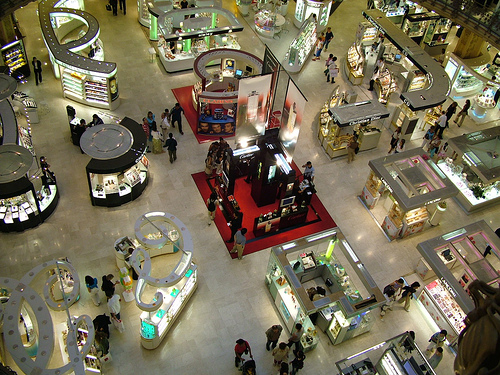
Nevertheless, I’ve maintained my penchant for small luxuries: pedicures; magazines; Mrs. Meyers geranium-scented counter spray; and good makeup.  Yes – makeup.  While I’m sure that Maybelline and L’Oreal make stuff of fine enough quality, I am drawn to the mall’s shiny, crystal clear makeup counters with an urgency that defies intelligence.  I revel in the sheer vanity of good makeup, the blissful thirty-minute makeover sessions, the glee reaped from new cheek colors and sparkling eye shadows, perfectly sculpted lipsticks and luminescent glosses.

Last week, this weakness got the best of me.  After a lengthy day of writing and tutoring, I had plans to meet a friend for coffee.  Only traces of the scant makeup I’d put on in the morning remained.  Dark circles, intensified by droopy mascara, ringed my eyes.  I looked this way partly because I’d applied my makeup while driving that morning, and partly because I’d recently run out of concealer.  But the mall was on the way, and I imagined I could pop in to Nordstrom’s quickly and solve two problems – the droopy circles and my need for new concealer – at once.

I’ve read enough copies of Allure magazine in my lifetime to know that a girl should never go to a makeup counter looking the way I did, and that, once there, she should say, “I need concealer number 3,” not, “I’m looking for concealer, but I’m not sure which shade.”  Yet, I broke both rules.  With raccoon eyes and disheveled hair, I shuffled over to the TM counter and asked for help.

Jeanie, a perfectly powdered saleswoman, took one look at my bulging belly and faded foundation and her eyes lit up.  She’d just hit pay dirt.  Before I knew it, I was in the midst of a hard core makeover.

“What kind of foundation do you use?” Jeanie asked innocently.  I explained that my foundation was actually a tinted moisturizer, made by TM Competitor X.  She rolled her eyes and shook her head, as if I’d just told her I put dog food on my face each morning.  When she asked how I applied my makeup (to which I actually responded “with my fingers, in the car”) I knew I was in deep trouble.

Jeanie assured me that after thirty minutes with her (and a hefty sum spent on new TM makeup) I’d become the most beautiful pregnant person the world had ever seen.  She complimented me on my beautiful skin (once “good” foundation was applied), my motherly glow (once brightener was applied), and she feigned disbelief when she learned I’d recently entered my third trimester (unfortunately, no high-end makeup to help the bulging belly, but she could probably tell I needed the compliment).

Under normal circumstances, I’d like to think I’d see through Jeanie’s ruse.  But, in the thrilling midst of the high-gloss makeover, I buckled.  Would I like the brightener?  Yes.  The concealor?  Certainly.  The new foundation?  But of course.  A professional brush with which to apply my high-end makeup?  You bet.  The kicker came when Jeanie convinced me I needed a new TM makeup case to help me stay organized once Baby K arrives.  I can’t believe I said yes to that, but I did. At least when Jeanie asked (with new urgency) if I needed any mascara, I resisted.  Everyone knows only the truly duped fall for makeup counter mascara.

I left the mall feeling utterly taken, but – now at least this is true – prettier than I have in a while.  Thankfully, Nordstrom’s accepts returns on unopened makeup (and overpriced makeup organizers), and Jeanie wasn’t there the following day to rebuke me.

Don’t worry – I kept the concealer … and the foundation … and the brightener … but I took all the other stuff back.  If Gay Talese could indulge in handmade Italian suits and leather shoes at the beginning of his writing career, a little good makeup won’t hurt mine.

Interpreting Joy

bloomingpetals40x40.jpg

Earlier this fall, I founded a little artist’s group. I knew from previous freelancing experience how isolating (and depressing) it can feel to sit at home all day without access to humans except via email, and I was keen to find a way around that problem this go-round. At the recommendation of a knowledgeable friend, I picked up a book called The Artist’s Way, aimed at nurturing the creative spirit. The author, Julia Cameron, suggests readers form “creative clusters” for support and community.

My creative cluster consists of Kristina, a visual/decorative artist, Kerie, a photographer, Natasha, a graphic designer, and Laura, also a photographer – all women I respect and admire not only for their artistic talents, but also for who they are as people. Although we’re all in different creative fields, when we meet, we discuss the same sorts of things – how to balance art and commerce; what to do about taxes incurred by our small (tiny!) companies and how to bar against them; where to fill our creative wells, etc.

As I was leaving our group this past Monday, Kristina and Kerie began talking about the nature of their work. Kristina’s paintings are full of color, joy and life. She uses pink paint, often. Her work is bold, with a fun flare, and beautiful. Kerie does all sorts of photography (weddings pay the bills), but enjoys her work with children the most. She loves to bring out their liveliness and innocence, captures sly, mischievous smiles and quirky personalities.

Both girls talked about their peers from art school, who were so focused on finding reflective meaning within their paintings and photographs that they seemed to discount the value of something that was simply beautiful, or dear. I remember feeling a similar tension while studying poetry in college. It seemed all “legitimate” poets were writing about fear, death, longing or depression. With varying degrees of success, my peers there followed suit. I sort of tried to walk into the shadows, but always felt I came off as a sham, and there’s nothing worse than insincere poetry.

Still, the “true artist” stereotype sometimes serves as a deterrent to my own work. I imagine that I will not achieve real success with my writing unless I addict myself to an illicit drug (or maybe just some painkillers), go crazy or become madly self-centered. Unfortunately (I mean, fortunately), I’m just not wired that way, and I kind of like my balanced life as it is. I try to remind myself that there are plenty of wonderful, “legitimate” artists out there whose work has tracings of both light and shadow, who are not destitute, and whose lives are not in shambles.

But the question remains, can art be joyful and still be considered art? I think so. If all artists were tortured souls, searching for an outlet for their grief, the world would be in a very sad state, indeed.

FYI: The painting, above, is by my friend Kristina.  It is one of my favorites.

Time Out

271762718_28e8fb28a1.jpg

Since so many of you offered me helpful feedback on my manuscript/book proposal, I thought I’d take a little break from my travelogue to give you the latest update on my agent search.

Prior to leaving for Italy, I sent four chapters of my much-revised manuscript to JW in New York City. For those of you who don’t have the pleasure to experience this, sending out a manuscript feels a little like sitting in a quiet room while watching someone else read writing you’ve bled onto the page. So, I decided that abiding the silence while in Tuscany was one of the best lines of defense ever. If JW hated my newest batch of writing, it wouldn’t hurt so much to hear about it while in, or shortly after returning from, Europe.

As it turns out, I didn’t hear from JW during the two weeks we were gone, but got a lovely email upon my return to the States. He’s not interested in selling the Bluebird, but he is interested in my writing and would be interested in working with me on something else – if the muses stirred. A mixture of relief and slight (really only slight, much to my surprise) disappointment washed over me when I read his email.

If JW had decided to sign me up and shop the Bluebird around to publishers, I’d begun to wonder how I would get the writing done, and if I would, in the end, be a huge disappointment to him and to myself. Plus, with the impending arrival of Baby Kintz in February, and at least 4 or 5 months more of reporting and research to do on the Bluebird as a whole, time felt incredibly slight. In the face of all this my energy for the project was beginning to lag, and I wondered if I’d be able to revive my passion enough for a publishing deal.

Don’t worry – I have had moments when I’ve felt my writing career might be over, and that I’ve already written my one good idea … I’m not that abnormal. But there’s also a part of me that’s keen to embrace the possibility of a new adventure with my writing, and my hope was buoyed by JW’s affirmation of my work as a writer, if not the “salability” of my idea. Now, if only those Southern muses would stir!

Gradually, I am learning that this thing I’m doing takes more faith and passion than it does ambition, and since I can’t seem to do anything else with my life other than write, I might as well keep at it …

Everybody’s A Snob About Something

100_0774.jpg

Today, I went to Binders – an art and craft/framing store – to get a mat board for an etching Andrew and I picked up from a street artist in Florence. We found the etching’s artist in a courtyard near the Uffizi Gallery, among several other vendors selling artworks of Florence and Tuscany.

There was something I liked about this artist, beyond his work. He had an easy way about him and was less conspicuous than the others, smoking cigarette after cigarette while working on a copper etching block. He seemed content and absorbed in his work. He had a graying beard, and big, brown, deep-set eyes. He didn’t seem to care, really, if we wanted to buy his stuff or not, but he was clearly pleased when we showed more than just passing interest. His etchings were lovely – mostly panoramas of the city, with Brunnelleschi’s duomo in the forefront – and they weren’t too expensive. 35 Euros bought us a nice-sized print – half the price of what we would have paid if we’d bought it in a Florentine boutique.

Upon our return to the States, I was excited about displaying our little piece of Florence. But typically, I feel a little intimidated at art & craft stores. I like to walk the aisles and imagine myself doing something highly artistic … or, let’s face it, even just colorful … but I know my limitations. So, today I approached the custom framing counter feeling a little silly, carrying a huge “liberty blue” mat that I hoped could be cut to size by someone other than myself. (I am left handed and a disaster with scissors and most other sharp things.) I rang the bell, and in a short time a red-headed guy with a scrubby goatee and very artistic looking wire-rimmed glasses greeted me.

He seemed a little annoyed by the gigantic blue mat, my Target-brand frame and the Florentine etching. I explained I just wanted it cut to size, that I didn’t know how big to make the window for the etching to show through and that I would trust his judgment. He sighed deeply and took out a tiny, pocket-sized measuring tape. (Should I have made an appointment, I wondered?)

At about that time, someone came over the loudspeaker and made an announcement for the frame shop. My disgruntled frame guy sighed again, more deeply still, and said, to no one in particular, “It never fails. I’m here alone, the bell rings, and all of a sudden everyone needs me.” I didn’t quite see how stressful life behind the custom frame shop counter could be, but I smiled sympathetically anyway.

A moment later, the frame guy whisked away my big blue mat and the Florentine print and went to a back room. I heard mechanized slicing sounds and worried about our little etching, wondering if the disgruntled artist would take out his frustrations on Florence. He didn’t. Instead, he emerged with a perfectly cut liberty blue mat in just the right size, with a massive scrap of mat board left over for me to take away. I asked if they wanted to use the mat board scrap for any reason, to which he sort of rolled his eyes and said, “No. We use a better quality board than that back here.”

Oh. Sorry.

I actually thought it was kind of funny – that everyone has something about which they are inordinately snobby. For some of us – those of us who eschew Chicken Soup for the Soul type books and Dan Brown-esque novels – it’s a specific type of writing; for others of us, it’s mat boards. Go figure!

I did wonder what our street artist would think of my el cheapo frame job, but decided that he’d just shrug and light up another cig, or maybe just close up shop for the day to grab a late afternoon cup of espresso.

The Punches

100_0744.jpg

Andrew and I consider ourselves at our very best when traveling. We’re into (cautious) adventure; we like to learn stuff; we love to wander and find ourselves in restaurants/b&bs/towns not mentioned in the guidebooks. We like to hang out and play card games and to sleep in – even in Italy, where there is so much to see we really should have gotten up at 6 am every day. We are often so relaxed while traveling together that very little can stand in the way of our good time.

On this most recent trip, however, we did encounter a few snafus that almost made us lose our cool. Europe by car is not for everyone. Lots of people would be scared out of their wits to get on the Italian Autostrade in a snazzy little Fiat wagon with psychotic Italian drivers on all sides, and even the bravest adventurer might opt for a cell phone and/or one of those automated Magellan gadgets that tells you where to turn to find your agritourismo. But not us.

No, the ever-intrepid Kintzes took to the Autostrade with gusto, armed only with a detailed map of Tuscany, a bag of apples and a tank full of diesel. At first, we fared well. We made it out of Pisa in one piece, found our first agritourismo after only three or four wrong turns, and discovered a convenient 45-minute train into Florence from the small town where we were staying that would keep us and the Fiat safely away from city driving.

On our first day of sight-seeing, we walked from 10:30 am until 10 pm. We looked at art and architecture until our eyes crossed.  But it was on the night’s last train from Florence to Montevarchi that our luck began to turn.  Once on board, Andrew promptly fell asleep and I engrossed myself in the Frommer’s guide to make a plan for the following day. After what seemed like a very short time, I thought I heard a faint announcement saying something about Montevarchi, but I was in a daze. I woke Andrew up. He confirmed (groggily) that we’d reached our destination, so we hopped up, gathered our things, and headed for the door. Yet, when we tried to open the door, it wouldn’t budge. We pulled and pushed and banged. No luck. Minutes later, the train started moving again.

This was a very, very bad thing. The train’s next stop was Arezzo – as far away from Montevarchi as Florence, and, in October, a tiny, forgotten place. I guess it is probably beautiful – most towns in Tuscany are – but when we finally reached it at midnight on our first day in Italy, it might as well have been Hell’s second circle. There were no buses to be seen, no hotels in sight, no cabs lined up at the taxi stand. We were a good 40 kilometers from our agritourismo,  no trains were going back that way until the morning, and both of us were so tired we felt like we might cry.

Eventually, we did find ourselves a cab.  He was one of only two cabbies in the whole city, though, and he spoke only Italian.  He also did not seem to be thrilled about driving two American tourists 40 ks to a train depot.  After paying him the $75 fare (so much for souvenieres) he dropped us off about a mile’s walk from the Montevarchi train station.  By the time we got in bed, it was close to 2 am.

Of course, such things are to be expected when traveling; we’d just forgotten how to compensate for them.  After a few more snafus (getting lost, nearly getting smushed by a number of cars & scooters, encountering a very drunk, tip-hungry houseboy at one of the cottages we rented, and marching with 200,000 to Assisi (more on that later)) we learned to appreciate – at least in retrospect – the surprises and stories that might emerge from such adversities.

Libraries Burning

A few years ago, after Andrew and I first got married, we quit our jobs and blew our savings on the trip of a lifetime. We had friends in Australia and New Zealand who had offered us a place to stay (rent-free) for a few months. Some other American friends had gone to South Africa on a similar savings-blowing trip. They introduced us to their South African friends, Garth and Bridget, who extended hospitality by way of their Cape Town home’s back wing, complete with kitchenette and private entrance.

South Africa was first on our four-month travel itinerary. While there, Garth & Bridget gave us an old maroon Honda Accord to drive; they invited us to join them for dinner almost every night of our month-long stay. They welcomed us as though we were long-lost family members, as if they had known about us from birth and were overjoyed to lay eyes on us at last. Theirs was a welcome that far surpassed any Southern graces I have ever known.

Yet, I arrived in South Africa full of distinctively American anxieties. I was somewhat fearful of contracting malaria, worried about the place’s fledgling democracy and unrest resulting from its 40% unemployment rate, nervous about the rampant cases of HIV and AIDs, the sort of stuff – rapes and racial tensions – I’d read about in J.M. Coetze’s Disgrace.

In reality, the country was no less complex than that which I had imagined (though it was less dangerous), but it was also significantly more beautiful – in people and geography – than I could have guessed. Andrew and I spent days walking around Cape Town, driving across mountain ranges, drinking great South African wine. When we mentioned we wanted to see other sides of S.A., Bridget, a nurse, introduced us to some friends who worked in a poor township’s orphanage; the babies there, all HIV-positive, crawled all over us, touching our faces, hungry for human warmth.

A friend who had spent many years in Tanzania once said of the continent: “Africa just gets in your bones,” and it does. When we left, I felt a piece of it had become a part of me.

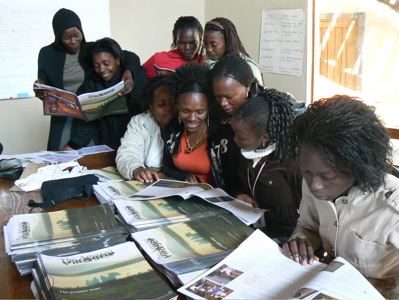
Happily, when I enrolled in my MFA program, I met a young woman named Maggie Messitt. Maggie is an American narrative journalist based in a small town in South Africa; in addition to telling the stories of her South African neighbors, she has singlehandedly started a non-profit organization charged with the purpose of teaching young South African women how to tell their personal stories and their country’s stories. She calls the nonprofit “Amazwi,” which means “voices” in Zulu.

In any country, the effort to train and empower writers to record their lives and celebrate their native cultures could be regarded as a significant contribution to humankind. But add to this the staggering numbers of parents who die before their children are old enough to speak (due to AIDs), the nonexistence of public libraries, and the view of education as luxury, and the importance of the written word looms even larger.

Amadou Hampate Ba, a Malian writer and UNESCO representative, has said, “In Africa, when a man dies, it’s a library burning.” Thanks to Maggie Messitt and her dedicated staff of volunteers, this is slightly less true for South Africans. Their “libraries” databases are being preserved; through the Amazwi students’ narratives, the stories, languages, wisdom and experience of elders are finding a place in a quietly emerging canon of African literature.

This morning, I received an email update from Amazwi which included a poem written by one of the program’s students, Amukelani Mashele. Inspired by her Shangan heritage, she writes:


I work hard to leave footprints wherever I step

I never let challenges bring me down, so I dare anyone

I refuse to let someone judge me because,

Of Xitsonga that I speak or fair colour of my skin

Who can love me more than my own self? …


I am my own favourite person …


I am proud to support an organization that seeks to preserve national history while empowering young women to find their own voices, women who “work hard to leave footprints wherever [they] step”; women who maintain such self-respect that they can write, without twittering with insecurity, “I am my own favourite person.”


To learn more about Amazwi’s aims and programs, and its new literary magazine, A., please click on the Amazwi link on my blogroll or go to http://www.amazwi.org.


Becoming Greenific

Leg Warmers

Ok … time for another confession.

Even though I grew up on a farm, I have never been much of a tree hugger. In fact, I am so poorly versed in eco-friendly culture, I have no idea whether or not it is all right to call anyone a tree hugger or not, even when referring to one’s self. This may be the equivalent of using other offensive, outmoded words – and I would just have no idea.

It’s not that I don’t care about the earth, but that I grew up in a place where the land and its resources were so enmeshed with daily life that they required little extra thought. The farmers seemed to take good care of our pastures. (That was their job.) My dad led soil and water conservation for years and prided himself on his best practices. But I guess I always thought of these things in economic terms: you turn off the water while brushing your teeth because if you waste water, you waste money; same with the lights, and shutting the door behind you, and running the attic fan instead of the air conditioning. Conserving soil and water on the farm seemed also to reap financial rewards, although I do remember my dad mentioning something about erosion, and that it was bad.

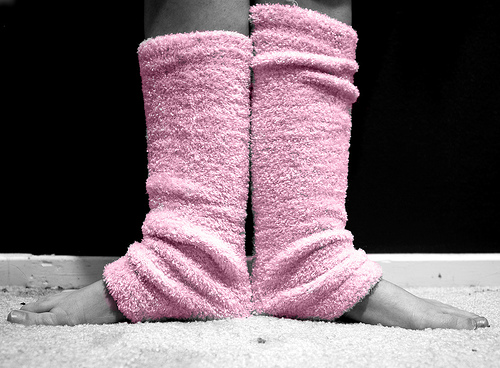
These days, conservationists are all the rage. Thanks to An Inconvenient Truth, Al Gore and global warming have become national celebrities. Going green has taken on similar characteristics to the ’80s fitness rage. Reducing one’s carbon footprint is the 2000’s equivalent of jazzercise (sans leg-warmers).

I found An Inconvenient Truth almost unbearable to watch – not because I don’t like ‘ol Al, but because what he was saying was so true, and so devastating, and so big. It was like discovering that someone or something you’d been taught was immortal had been diagnosed with terminal cancer. Suddenly (but not really suddenly), we are the ones in charge of saving everything – not just our own lawns, but everyone else’s, too.

I have never been one to jump on bandwagons. If the entire world is talking about a novel (think The DaVinci Code), for example, I’d really rather not read it. But this whole carbon footprint thing has gotten under my skin. It goes beyond the bandwagon. It must.

I, for one, am going to follow in the steps of my awesome, aforementioned sister-in-law, Jupe. Jupe is always thinking of new ways to be ecologically sound, and, for her birthday, I found these awesome bags called Envirosax. They are extra-strong, reusable grocery bags, which means that you save our landfills and recycling facilities from some plastic – and look stylish in the process. Jupe loved them so much, I’ve decided I should get some, too. (They come five in a set, and hold two plastic bags worth of groceries each!)

Still, I fear that our little smartcars and our recycling drives and our styrofoam avoidance will go the way of jazzercise. For heaven’s sake – if our current health trends are any indication, our air and water don’t stand a chance. According to the American Obesity Association, since 1976 (my birth year), our population’s percentage of overweight people has risen from 46% to 64%; the rate of national obesity has more than doubled, from 14.4% to 30.5%. So much for jazzercise. (Were the legwarmers to blame?)

I don’t have any answers on how to be greenific (remember, I’m a newbie – officially “green” – ha!), but I am committed to being my own little green person in whatever way I can. I hope, for the world, carbon reduction becomes as enmeshed with daily life as the rhythms of the land were for me growing up.

If anyone has helpful suggestions on how to become more ecofriendly – beyond buying Envirosax and conserving energy – please make a comment on my blog.

Sitting on Rocks

203232853_7deb0bb85d.jpg

When I was a sophomore in college, I called my mother and told her that all I really wanted to do with my life was sit on a rock and write poetry. She laughed (nervously) and mentioned something vague about a stable income.* And, my memory is foggy on this now, but I think my father’s reaction involved waving a rather high credit card bill in my face and talking, with some amusement, about how to live on a meager poet’s salary.

100_0099.jpg

*”Stable Income”

Yet, what did they expect? Throughout my adolescent summers, Mama sent me to academic sleep-away camps; and, when Daddy was in an especially whimsical mood, he would recite poetry at the dinner table (Donne’s “For Whom the Bell Tolls” was one of his favorites). Of all people, my sister – I assure you, the most practical of the two of us – majored in music, with a concentration in composition, and her music absolutely soared. Even if they’d all tried – which they didn’t, not really – they couldn’t have talked me out of poetry.

I loved – and love – poetry for its rhythm and vibrance, its uncanny ability to distill big truths with perfect precision. When I am at my most creative, my writing always goes back to poetry. I fall into this habit not because I am such a spectacular poet, but because that’s just how words naturally fall out of my head. I am drawn to peculiar images – big trees with crazy limbs, for example, or a semi-professional wrestler who also cuts women’s hair for a living – and I like to write around the images, attaching tiny themes to make them work in a poem. Sometimes this works well in nonfiction, too, but it has to be done sparingly. Otherwise, it appears as though the author is preening her feathers.

Obviously, I’ve strayed a bit from poetry, but I recently picked up Garrison Keillor’s edition of Good Poems, and it has inspired me again. There are so many good poems to read – poems that will make you laugh like crazy, or want to cry, or make you see something in an entirely new way – and there are so many great rocks out there in the world to sit on. Best of all, poems can be taken in in a sitting, like a shot of whiskey, and just like that, your whole day is different.

I write this so that all the poets in the world with high credit card bills can make their interest payments every month. In today’s literary marketplace, to make it as a poet means that you have probably met an angel who let you try on his halo. It is more difficult (and, oddly, less financially rewarding) than trying to make it in any other genre.

There are poems in this world for everyone – not just for people who like Shakespearean sonnets or Wallace Stevens’ abstractions. For the faint of heart, clicking on The Writer’s Almanac site on my Blogroll would be a great place to start. The poetry aisle – yes, there is such a thing – at a local bookstore is for the braver souls among you; because I have received such helpful feedback from you all on my own writing recently (thank you!), I’m confident you’re up for the challenge.

Happy reading!

Curious

tk-bk-7-12-zm.jpg

tk-bk-7-12-zm.jpg

As many of you may (or may not) know, for the past two years, I’ve been working on a manuscript about songwriters in Nashville. It started out as a thesis for my MFA program, but since I graduated I’ve been thinking of it more along professional lines. I haven’t mentioned it here because I tend to be fairly quiet about such things, and because it makes me nervous.

The inevitable rejections a writer faces privately are tough enough, so you’ll rarely hear me or any other prudent writer I know touting the fact that she has just sent out seventeen book proposals to agents. The truth is that I tend to be pretty hesitant to send anything out (nothing’s ever perfect, you know) – which means that I’m often spared rejection, but also sparsely published. But, this summer, at the urging of a persistent advisor, I wrote a book proposal for Bluebird (see Jupe’s awesome book covers!) and sent it to one agent.

I got an email from him the day the FedEx hit his office in NYC. He asked me for three weeks’ exclusivity (pretty normal, from what I understand), to which I happily agreed. After his deadline was up, JW called me and asked me on what I imagine as the literary world’s equivalent of a second date. He said he liked my writing and that he liked the manuscript’s subject, but that he wanted to see a different chapter excerpt – preferably something more character based.

Now, because I was so sure that JW was simply going to send me a letter that said, “Thanks, but no thanks,” that he asked me out on a second date felt nothing short of miraculous. But, as second dates go, anxiety and intimidation set in; I realized that to give JW what he really wanted meant having to rethink the structure of the whole manuscript – 225 pages of which I meticulously stitched together over the course of my two-year graduate program. For reasons I won’t bore you with, I believe that taking the whole darn thing apart is the right thing to do. But I have been stalling, unsure of how to proceed.

This week, however, I gave myself an October 1 deadline. Whether JW wants the second date by then or not – he said there was no rush – he’s getting it. Otherwise, Bluebird will never be heard from again.

Now – I’d like to ask a favor of you. I’m curious to see if any of you would read the attached document (lorna-revised.doc, below) and tell me – honestly – if you’re intrigued. I need this thing to jump right off the page; I need you to be hungry for more of the story. If it doesn’t, and you can’t get past page two, please tell me. Thanks!