Time Out

271762718_28e8fb28a1.jpg

Since so many of you offered me helpful feedback on my manuscript/book proposal, I thought I’d take a little break from my travelogue to give you the latest update on my agent search.

Prior to leaving for Italy, I sent four chapters of my much-revised manuscript to JW in New York City. For those of you who don’t have the pleasure to experience this, sending out a manuscript feels a little like sitting in a quiet room while watching someone else read writing you’ve bled onto the page. So, I decided that abiding the silence while in Tuscany was one of the best lines of defense ever. If JW hated my newest batch of writing, it wouldn’t hurt so much to hear about it while in, or shortly after returning from, Europe.

As it turns out, I didn’t hear from JW during the two weeks we were gone, but got a lovely email upon my return to the States. He’s not interested in selling the Bluebird, but he is interested in my writing and would be interested in working with me on something else – if the muses stirred. A mixture of relief and slight (really only slight, much to my surprise) disappointment washed over me when I read his email.

If JW had decided to sign me up and shop the Bluebird around to publishers, I’d begun to wonder how I would get the writing done, and if I would, in the end, be a huge disappointment to him and to myself. Plus, with the impending arrival of Baby Kintz in February, and at least 4 or 5 months more of reporting and research to do on the Bluebird as a whole, time felt incredibly slight. In the face of all this my energy for the project was beginning to lag, and I wondered if I’d be able to revive my passion enough for a publishing deal.

Don’t worry – I have had moments when I’ve felt my writing career might be over, and that I’ve already written my one good idea … I’m not that abnormal. But there’s also a part of me that’s keen to embrace the possibility of a new adventure with my writing, and my hope was buoyed by JW’s affirmation of my work as a writer, if not the “salability” of my idea. Now, if only those Southern muses would stir!

Gradually, I am learning that this thing I’m doing takes more faith and passion than it does ambition, and since I can’t seem to do anything else with my life other than write, I might as well keep at it …

Libraries Burning

A few years ago, after Andrew and I first got married, we quit our jobs and blew our savings on the trip of a lifetime. We had friends in Australia and New Zealand who had offered us a place to stay (rent-free) for a few months. Some other American friends had gone to South Africa on a similar savings-blowing trip. They introduced us to their South African friends, Garth and Bridget, who extended hospitality by way of their Cape Town home’s back wing, complete with kitchenette and private entrance.

South Africa was first on our four-month travel itinerary. While there, Garth & Bridget gave us an old maroon Honda Accord to drive; they invited us to join them for dinner almost every night of our month-long stay. They welcomed us as though we were long-lost family members, as if they had known about us from birth and were overjoyed to lay eyes on us at last. Theirs was a welcome that far surpassed any Southern graces I have ever known.

Yet, I arrived in South Africa full of distinctively American anxieties. I was somewhat fearful of contracting malaria, worried about the place’s fledgling democracy and unrest resulting from its 40% unemployment rate, nervous about the rampant cases of HIV and AIDs, the sort of stuff – rapes and racial tensions – I’d read about in J.M. Coetze’s Disgrace.

In reality, the country was no less complex than that which I had imagined (though it was less dangerous), but it was also significantly more beautiful – in people and geography – than I could have guessed. Andrew and I spent days walking around Cape Town, driving across mountain ranges, drinking great South African wine. When we mentioned we wanted to see other sides of S.A., Bridget, a nurse, introduced us to some friends who worked in a poor township’s orphanage; the babies there, all HIV-positive, crawled all over us, touching our faces, hungry for human warmth.

A friend who had spent many years in Tanzania once said of the continent: “Africa just gets in your bones,” and it does. When we left, I felt a piece of it had become a part of me.

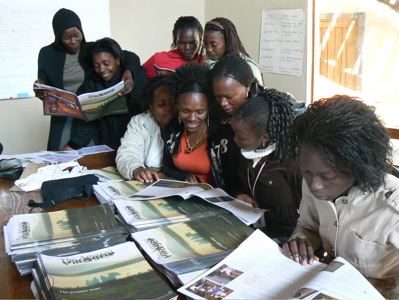
Happily, when I enrolled in my MFA program, I met a young woman named Maggie Messitt. Maggie is an American narrative journalist based in a small town in South Africa; in addition to telling the stories of her South African neighbors, she has singlehandedly started a non-profit organization charged with the purpose of teaching young South African women how to tell their personal stories and their country’s stories. She calls the nonprofit “Amazwi,” which means “voices” in Zulu.

In any country, the effort to train and empower writers to record their lives and celebrate their native cultures could be regarded as a significant contribution to humankind. But add to this the staggering numbers of parents who die before their children are old enough to speak (due to AIDs), the nonexistence of public libraries, and the view of education as luxury, and the importance of the written word looms even larger.

Amadou Hampate Ba, a Malian writer and UNESCO representative, has said, “In Africa, when a man dies, it’s a library burning.” Thanks to Maggie Messitt and her dedicated staff of volunteers, this is slightly less true for South Africans. Their “libraries” databases are being preserved; through the Amazwi students’ narratives, the stories, languages, wisdom and experience of elders are finding a place in a quietly emerging canon of African literature.

This morning, I received an email update from Amazwi which included a poem written by one of the program’s students, Amukelani Mashele. Inspired by her Shangan heritage, she writes:


I work hard to leave footprints wherever I step

I never let challenges bring me down, so I dare anyone

I refuse to let someone judge me because,

Of Xitsonga that I speak or fair colour of my skin

Who can love me more than my own self? …


I am my own favourite person …


I am proud to support an organization that seeks to preserve national history while empowering young women to find their own voices, women who “work hard to leave footprints wherever [they] step”; women who maintain such self-respect that they can write, without twittering with insecurity, “I am my own favourite person.”


To learn more about Amazwi’s aims and programs, and its new literary magazine, A., please click on the Amazwi link on my blogroll or go to http://www.amazwi.org.


Sitting on Rocks

203232853_7deb0bb85d.jpg

When I was a sophomore in college, I called my mother and told her that all I really wanted to do with my life was sit on a rock and write poetry. She laughed (nervously) and mentioned something vague about a stable income.* And, my memory is foggy on this now, but I think my father’s reaction involved waving a rather high credit card bill in my face and talking, with some amusement, about how to live on a meager poet’s salary.

100_0099.jpg

*”Stable Income”

Yet, what did they expect? Throughout my adolescent summers, Mama sent me to academic sleep-away camps; and, when Daddy was in an especially whimsical mood, he would recite poetry at the dinner table (Donne’s “For Whom the Bell Tolls” was one of his favorites). Of all people, my sister – I assure you, the most practical of the two of us – majored in music, with a concentration in composition, and her music absolutely soared. Even if they’d all tried – which they didn’t, not really – they couldn’t have talked me out of poetry.

I loved – and love – poetry for its rhythm and vibrance, its uncanny ability to distill big truths with perfect precision. When I am at my most creative, my writing always goes back to poetry. I fall into this habit not because I am such a spectacular poet, but because that’s just how words naturally fall out of my head. I am drawn to peculiar images – big trees with crazy limbs, for example, or a semi-professional wrestler who also cuts women’s hair for a living – and I like to write around the images, attaching tiny themes to make them work in a poem. Sometimes this works well in nonfiction, too, but it has to be done sparingly. Otherwise, it appears as though the author is preening her feathers.

Obviously, I’ve strayed a bit from poetry, but I recently picked up Garrison Keillor’s edition of Good Poems, and it has inspired me again. There are so many good poems to read – poems that will make you laugh like crazy, or want to cry, or make you see something in an entirely new way – and there are so many great rocks out there in the world to sit on. Best of all, poems can be taken in in a sitting, like a shot of whiskey, and just like that, your whole day is different.

I write this so that all the poets in the world with high credit card bills can make their interest payments every month. In today’s literary marketplace, to make it as a poet means that you have probably met an angel who let you try on his halo. It is more difficult (and, oddly, less financially rewarding) than trying to make it in any other genre.

There are poems in this world for everyone – not just for people who like Shakespearean sonnets or Wallace Stevens’ abstractions. For the faint of heart, clicking on The Writer’s Almanac site on my Blogroll would be a great place to start. The poetry aisle – yes, there is such a thing – at a local bookstore is for the braver souls among you; because I have received such helpful feedback from you all on my own writing recently (thank you!), I’m confident you’re up for the challenge.

Happy reading!

Curious

tk-bk-7-12-zm.jpg

tk-bk-7-12-zm.jpg

As many of you may (or may not) know, for the past two years, I’ve been working on a manuscript about songwriters in Nashville. It started out as a thesis for my MFA program, but since I graduated I’ve been thinking of it more along professional lines. I haven’t mentioned it here because I tend to be fairly quiet about such things, and because it makes me nervous.

The inevitable rejections a writer faces privately are tough enough, so you’ll rarely hear me or any other prudent writer I know touting the fact that she has just sent out seventeen book proposals to agents. The truth is that I tend to be pretty hesitant to send anything out (nothing’s ever perfect, you know) – which means that I’m often spared rejection, but also sparsely published. But, this summer, at the urging of a persistent advisor, I wrote a book proposal for Bluebird (see Jupe’s awesome book covers!) and sent it to one agent.

I got an email from him the day the FedEx hit his office in NYC. He asked me for three weeks’ exclusivity (pretty normal, from what I understand), to which I happily agreed. After his deadline was up, JW called me and asked me on what I imagine as the literary world’s equivalent of a second date. He said he liked my writing and that he liked the manuscript’s subject, but that he wanted to see a different chapter excerpt – preferably something more character based.

Now, because I was so sure that JW was simply going to send me a letter that said, “Thanks, but no thanks,” that he asked me out on a second date felt nothing short of miraculous. But, as second dates go, anxiety and intimidation set in; I realized that to give JW what he really wanted meant having to rethink the structure of the whole manuscript – 225 pages of which I meticulously stitched together over the course of my two-year graduate program. For reasons I won’t bore you with, I believe that taking the whole darn thing apart is the right thing to do. But I have been stalling, unsure of how to proceed.

This week, however, I gave myself an October 1 deadline. Whether JW wants the second date by then or not – he said there was no rush – he’s getting it. Otherwise, Bluebird will never be heard from again.

Now – I’d like to ask a favor of you. I’m curious to see if any of you would read the attached document (lorna-revised.doc, below) and tell me – honestly – if you’re intrigued. I need this thing to jump right off the page; I need you to be hungry for more of the story. If it doesn’t, and you can’t get past page two, please tell me. Thanks!

A date! A date! A very important date!

526871574_0619de9d78.jpg

Today, I did for the first time what I hope will become a habit: I took myself on a date. I did this at the urging of The Artist’s Way, a book written by a woman named Julia Cameron for people (artists and non-artists) who want to augment their artistic lives. Cameron writes, “We forget that the imagination-at-play is at the heart of all good work … in order to have a real relationship with our creativity, we must take the time and care to cultivate it.” I took her at her word.

My date was to the High’s Annie Leibovitz exhibit, something I’d been meaning to get around to, but for which I had somehow never found the time. After a bright, breezy morning with Ivy and Andrew at the park, I showered quickly (who was there to impress, after all?), threw on my flip-flops and the most comfortable dress I own, and drove to Midtown.

Immediately, I savored the freedom of all this; the bold stroke of life on my own schedule. And it’s not that anyone in my life demands so much of me that it is a burden, but there is something deliciously indulgent about not having to apologize for parking a mile from the museum (in 90 degree weather) because you are too cheap to pay for parking, of walking through an art exhibit alone without feeling the need to respond to anyone’s opinion or curiosity, without worrying whether you’re spending too much time at each photo or not enough. Add to this the fact that I have been waist-deep in Khaled Hosseini’s A Thousand Splendid Suns, and the freedom tasted that much sweeter. (I am so moved by this book, I can’t even write about it yet. If you have not read it, you must.)

My experience with myself and Annie Leibovitz’s photographs (from both her personal and private collections) was filled with both a thrilling appreciation for beauty and startling emotion. I stayed there for two hours, looking for stories in every photo.

I became fixated on one photograph of Leibovitz’s parents on their 50th wedding anniversary, on another of a pool of blood beside a fallen bicycle in Sarejevo, and another of two circus performers: a woman was strapped to a massive red and white bullseye – on her face was a look of total boredom and resignation; a man stood in front of her and took aim with a dagger. I cried at the sight of Johnny Cash, June Carter and Roseanne Cash playing music on their front porch in Kentucky. I cried again when I came to Leibovitz’s photo of bloody footprints left from the massacre at a schoolhouse in Rwanda. Again, I cried at the photos preceding Susan Sontag’s death, and the death of Leibovitz’s father. Leibovitz captured each scene, each tiny moment, with curiosity, dignity, a raw and naked tenderness.

This afternoon, while standing in the High Museum, where everything is brilliantly white and crisp (its design reminds me of what it might be like to live inside an iPod), it struck me that all art – drama, visual art, music, writing, etc. – is connected by that which is alive in all of us. The spirit of great art is the thing that moves us from hope to despair and back again. It leans in to curiosity — not just to beauty and freedom, but also into ugliness and rage. Art is always looking for answers, retribution, a kind of hope that sees clearly the pain and unfairness of the world but continues to demand more of it.

After leaving Leibovitz, I wandered into the High’s museum store and was overcome with the urge to buy something beautiful. I recognized in this a desire to bottle my experience, to bring it home with me and put it on a shelf – as if a painted porcelain bowl or a coffee table book would somehow infuse my living and work space with a better sense of purpose, or some higher plain of artistry.

But the truth is that such things can only stretch so far. Eventually, I would flip through the $75 coffee table book out of moral obligation, would, at some point, pass the beautiful serving bowl and think, with disdain, that it needed dusting. I’m all about cherishing beautiful things, but then again, we have museums for a reason. They show us what to look for and help us to see. They silence the noise in the background and force us to take notice.

To make some odd purchase – a postcard? a High Museum pencil set? a brightly painted umbrella? – would have cheapened the experience for me. As if I’d won myself a stuffed panda by playing skee ball at a country fair. So – the beauty will have to wait for my next artist’s date. Luckily, Cameron prescribes one per week.

Seeking Narnia

Ok – I’ll admit it.  I have been having a hard time getting back into my blog.  For some reason – and this is really silly – I feel I must clarify that this is not because of anything you, dear reader, have done.  The issue is my own, not lagging numbers or lacking commentaries on my posts.

If I don’t write for a little while, the blank page takes over and begins to creep into my brain.  I freeze up and forget that ideas are everywhere and that the fun is in the Narnia factor: capturing the language so that it paints a picture for people, or moves them, or takes them into a dimension they never imagined they might know.  I stare at the computer screen and think about boring things, things no one would be interested in reading about (like, who are all the people after whom roads in Georgia are named? Are any of them connected?  Could I write a book on them? These thoughts go on for five minutes or more before I come to the stunning realization that I may be capable of forming some of the world’s worst book ideas).  Then, I imagine that the space where my brain should be is actually made up of a vast, dark, miasma of nothingness.  I convince myself that the things I think about are completely insignificant, and therefore unworthy of being written down.

But, now that I’ve started a blog, everything is different.  I am forced out of the nothingness and onto the page by Web-instituted boot camp.   My blog is out there, waiting.  The longer I stay away, the worse my writing will be.  The more I procrastinate, the more ridiculous the ideas will get.  So, I’m back, promising myself to be more consistent, if only for the good of the exercise.

In closing, a quote that defies the nothingness spiral:

“We say we waste time, but that is impossible.  We waste ourselves.” ~ Alice Bloch

Integrity

Now there’s a good word.

The root of integrity is from the Latin word integritatem, meaning “soundness” or “wholeness.” In 1450, the French took that root a step farther and coined the word integrite, which meant to them not just to be whole, but to be “in perfect condition.”*

I love etymology (officially “the study of historical linguistic change as manifested in individual words or parts of words”) because it reminds me of the legacies language leaves, and how language builds upon itself to enrich and complicate our everyday communication. Knowing the roots of certain words can be incredibly clarifying. Today, we think of integrity as a moral trait, something that is even debatable. However, if taken at its Latin root, there is actually no room at all for debate. The word means something much more tangible: to have integrity is to be solid, whole and of sound mind.

In a fit of irritation, I thought of this particular word today. On almost every news portal, Lindsey Lohan was making front page news for initiating a car chase against her personal assistant’s mother while under the influence. Meanwhile, the NFL’s decision to ban Michael Vick from training camp “blindsided” the Falcons, and former NBA referee Tim Donaghy – a person charged with upholding rules – admitted to participating in bets for games he’d worked over the course of two years.

Call me old-fashioned. But have we no integrity? And doesn’t anyone care?

90596053_1f6cdf1090_m.jpg

Clearly, the things these people have done (or allegedly done) are not right at all. Lindsey can’t get a grip on her addictions. She’s having a rough time. Ok. But why does this news – when there are fires burning in Nigeria that can be seen from outer space, for instance – get so much air time? Does the American public really care about Lindsay’s latest run-in with the law? If so, that says something [scary] about our culture, the things we value, our soundness of mind.

Vick and Donaghy’s stories are, of course, more spectacular in a way and therefore more worthy of the headlines. But even so, the nature of their crimes – and the public’s somewhat wishy-washy responses to them – leave me with a cold, clammy feeling.

I fear we Americans, so fraught with angst and division about war, politics, and religion are losing sight of integrity at its root: what it means to be whole. It is easier, of course, and even fanciful, to think about Lindsey’s latest mishap or the perils of an accused pro football player versus complex world events with truly significant consequences. So maybe I’ve just poo-pooed our fragile public’s main coping mechanism. But the reality is that we’ve got to pull ourselves out of la-la land ASAP. Just as words leave future users a legacy in language, we are now in the process of charting the course for our nation’s future citizens.
So go do something sane; be someone relevant. Care about something bigger. And then call CNN.

*I found these definitions on the Online Etymology Dictionary at etymonline.com

Work

A story about James Joyce:

A friend came to visit him one day and found Joyce sprawled across his writing desk in a posture of utter despair. “James, what’s wrong?” the friend asked. “Is it the work?”

Joyce indicated assent without even raising his head to look at the friend. Of course it was the work; isn’t it always?

“How many words did you get today?” the friend pursued.

Joyce (still in despair, still sprawled facedown on his desk): “Seven.”

“Seven? But James … that’s good, at least for you!”

“Yes,” Joyce said, finally looking up. “I suppose it is … but I don’t know what order they go in!”

– From Stephen King’s On Writing

A Michael Bittner Pic - from Flickr

Writing is hard.

This is something you won’t often hear from those of us who spend our days stringing words together, but it’s true, and there are a lot of books filled with writing advice to prove it.

Stephen King’s On Writing is as entertaining as it is illuminating. Like many other well-known writers’ handbooks (Anne Lamott’s Bird by Bird springs to mind here, too), King’s work of prescriptive genius is a combination of sage advice and memoir.

I approached On Writing with some trepidation. For one, I don’t write fiction. Specifically, I don’t write – or even really read – horror stories (they get too much in my head). But I admire Stephen King for his daring, and for his commitment to truth, and for the ways his wacky ideas fall so gracefully on the page. He is a master of storytelling.

This last fact proved to be no less true in On Writing than it was in It, or Carrie or The Shining. Even readers with little interest in learning how to write would enjoy King’s savvy rendering of writing as a tale worth telling. His love of language springs up amid the antics of his bizarre childhood (fueled by his bizarre imagination) and the drama of his alcoholism and recovery. Throughout, King writes of a dogged, joyful, no-B.S. commitment to his work that is, at once, clarifying, fear-inducing and inspiring.

A few words of Kingian wisdom:

Life isn’t a support system for art. It’s the other way around. (p. 101)

You can approach the act of writing with nervousness, excitement, hopefulness, or even despair – the sense that you can never completely put on the page what’s in your mind and heart. You can come to the act with your fists clenched and your eyes narrowed, ready to kick ass and take down names. You can come to it because you want a girl to marry you or because you want to change the world. Come to it any way but lightly. (106)

Stories are relics, part of an undiscovered pre-existing world. The writer’s job is to use the tools in his or her toolbox to get as much of each one out of the ground intact as possible. (164)

Talent renders the whole idea of rehearsal meaningless; when you find something at which you are talented, you do it (whatever it is) until your fingers bleed or your eyes are ready to fall out of your head. Even when no one is listening (or reading, or watching), every outing is a bravura performance, because you as the creator are happy. Perhaps even ecstatic. That goes for reading and writing as well as for playing a musical instrument, hitting a baseball, or running the four-forty. If there’s no joy in it, it’s just no good. It’s best to go on to some other area, where the deposits of talent may be richer and the fun quotient higher. (150)

Bookshelf

After a two-year hiatus from reading fiction, I’ve picked it up again.

While in grad school, I immersed myself in the writing of great nonfiction authors: Agee, McPhee, Kidder, etc. You name ’em, I at least tried to read ’em. I was undeterred from nonfiction even during holiday breaks, alternating between narrative journalism and memoir in an effort to learn as much as I possibly could while I had immediate access to nonfiction experts (my professors).

To be honest, I didn’t even know how much I missed my cozy novels. I was even a little reluctant to read fiction again. After all, it had been so long, and I tend to treat books – and by extension, genres – like friends. How in the world would we get reacquainted after so much time had gone by? Would it be awkward? Would I lose interest?

Perhaps, I thought, it might lessen the shock to begin with historical fiction, or a smattering of short stories.

Bookworm

But no. As soon as I read the first page of Claire Messud’s The Emperor’s Children, fiction and I were back in good graces. Reading about make-believe characters in a make-believe world reminded me of the delicious escape books can provide. It tucked in the driven, learning-oriented side of my brain, giving it permission to take some much-needed rest.

For once, I wasn’t analyzing the book’s structure as I read, or its author’s interviewing techniques. I was reading for pure enjoyment, having returned to a playground that allowed me to grasp for the monkey bars or clamber across the jungle gym instead of spending all my time building things – or fighting – in the sand box.

Not that we nonfiction writers can’t learn a lot from our fiction sisters. Claire Messud’s descriptions of her characters are priceless. She rounds them out with impressive zeal, making them tangible – describing them more tangibly, even, than many accomplished nonfiction writers portray their real-life subjects. She notes one character’s “resemblance to a baby seal,” and another’s “Nabokovian brow.” Brilliant.

Messud also captures every detail of her characters’ surroundings, knowing – in an almost eerie show of authorial intuition – just what we readers need to see, noting, for example, “a long, plump, pillowed sofa stretched the length of one wall,” at a dinner party. Better yet, she writes that “upon it four women were disposed like odalisques in a harem.”

Yum.

In celebration of my return to a multi-genred life, I’ve set up a “Bookshelf” here on my blog, where all you lovely people can see what I’ve been reading, and where you, too, can recommend great books from your own libraries.

Happy reading …

On the Outskirts of a Forest

“Our life is a faint tracing on the surface of mystery, like the idle, curved tunnels of leaf miners on the face of a leaf. We must somehow take a wider view, look at the whole landscape, really see it, and describe what’s going on here. Then we can at least wail the right question into the swaddling band of darkness, or, if it comes to that, choir the proper praise. ” — Annie Dillard, Pilgrim at Tinker Creek

Gosh, I love Annie Dillard.

I cannot get enough of her sentences. They breathe. They literally inhale and exhale with such natural rhythm that to envy them would be to envy a baby’s sound sleep. Who but one with a gift for true loveliness would write of life as a “faint tracing of mystery,” or find inspiration for that thought in a leaf?

Recently, I’ve been analyzing what the point of writing is and why, more specifically, I’m so obsessed with it. Why all this fuss? Why the stress? The deadlines? The reading of a manuscript out loud, and then silently, and then, after a few more sentences have been adjusted, out loud again?

It is utter madness. But as much as I recognize how warped my perspective can be at times, there is such redemption in the act of writing, and in the act of reading other people’s. Sentences are a dark tunnel with light at the end. Or, they should be.

I think of this on the day after having announced my intentions to leave my current job. For almost two years I’ve been processing accounts payable for a property management company. Because I’ve been in graduate school while doing what would make most writers crazy, I’ve enjoyed it. It is predictable, structured, and completely rational – three things my writing and my writing life are not.

Because I have enjoyed this job and respect the people I’ve worked for, I had to stop and wonder if finishing graduate school were such a great reason to quit. I thought I might take the safe path – keep the financial stability, continue to reserve my writing time for 7pm to midnight and try to “make it work.”

Earlier this week, though, as I was loading numbers into an excel spreadsheet, contemplating whether to keep my job or give myself to my writing, I had a realization. Dividing my time between accounting and writing suddenly felt disabling, as though I would be cheating myself out of what Annie Dillard calls “the wider view,” allowing myself only a parcel of land, as opposed to an entire landscape.

And, as crazy as writing can make me, there is life in it; in it there are ideas from which conversation, reconciliation and enlightenment can arise. Even if all you people stop reading my blog and I never publish anything, I can still wander out into the world’s forest of words and pick all the wildflowers. And even if I’m the only one who gets to enjoy gathering them and arranging their bouquet, that will be – has to be – enough.

Numbers really do it for some people, and for them, I’m glad. My husband, for example, is a good bit smarter than I am and is fascinated with the sort of language of numbers. But as much as I appreciate and fear their complexity, I can’t find depth in them, or life in them, or anything about them that would make me want to stay up past my bed time.

So yesterday, I surrendered to language. Turning away from the practicality and structure of a numbered life, I stand on the outskirts of a forest, waiting for it to take me in.