A Million Trees

Recently, a friend recommended that I pick up Frederick Buechner’s book of collected sermons, Secrets in the Dark. I am a fan of Buechner’s writing because of his communion with the mystery of God, the drama of that which is unknown, and for the enlivened, enlightening way he engages in the spiritual realm. His work, though never thought of as this, is creative nonfiction at its best.

In the introduction to Secrets in the Dark, Buechner expresses frustration and sadness about the general public’s boredom with the predictability of religion. He cites that it is not the work or act of faith that is boring, but, all too often, our culture – which promotes Christianity as feeble-minded and same-old-same-old. In response, Buechner’s sermons keep his readers and listeners on their toes, calling out oddities and inconsistencies in scripture commonly overlooked, rounding out flat characters, diving leagues and leagues below the surface before emerging again, out of breath, shouting joyfully about the discovery of some precious truth.

Buechner is also particularly wonderful because he honors and respects (rather than judges) disbelief, asking his non-believing brethren only to allow themselves to entertain the “if” – the possibilities inherent in any mystery.

But, on to the whole point of this blog posting – a million trees. This morning, I read one of Buechner’s Christmas sermons named “The Birth.” In it, he gives voice and background to the holiday story’s characters: the Innkeeper, a Wise Man, and a Shepherd.

At the very beginning of the sermon, the Innkeeper says, “…to run anything in this world … is like being lost in a forest of a million trees, and each tree is a thing to be done. Is there fresh linen on all the beds? Did the children put on their coats before they went out? Has the letter been written, the book read? … A million trees. A million things. Until finally we have eyes for nothing else, and whatever we see turns into a thing. The sparrow lying in the dust at your feet – just a thing to be kicked out of the way, not the mystery of death. The calling of children outside your window – just a distraction, an irrelevance, not life, not the wildest miracle of them all. The whispering in the air that comes sudden and soft from nowhere – only the wind, the wind …”

In the past several weeks I have found myself wandering among the many trees (some planted, some wild) that have sprouted up and vie for my attention.

My days with Claire – so much the same that I could almost take her gummy grin, her delightful baby sounds for granted – are utterly consuming, segmented and mundane, exhausting and – yes – joyful in a way I did not know was possible. How tempting for motherhood and its tasks – the bathing, the changing, the feeding – to become a “thing” that must be done. And the same goes for my writing work, something that must be done for my spirit and my brain; the joy in that so easily extinguished by its necessity and the pressure I fix upon myself. There are other trees, some large, some small, some just sprouting new growth, and at times their presence feels overwhelming, offering not shade or sustenance, but looming shadow – a disorienting maze of obligation and responsibility.

Yet, in just a matter of a few sentences, I am reminded of the depth in each daily commitment, the importance of paying attention. The trees, though there are millions, serve more purpose than to be chopped down – ticked off our lists of things to do – but to give shelter. Each grove of trees, if planted carefully, can bring new meaning and possibility; fruit for the soul. I hope the forest through which you walk each day is filled with cool, mossy rocks and sturdy nooks between roots perfect for sitting, reflection, and quiet encouragement.
Oxford American Magazine – A Review

Be faithful to that which exists within yourself.
-Andre Gide

The quotation above appeared at the top of a freelance job posting email I received this morning. I found its presence there slightly ironic, because the sort of work that appears on this email list often begins with, “Do you want to write about cars?” and ends with, “Compensation: $10/story.” (I have found I may be keeping the subscription for the quotations alone.)

“That” which exists within me isn’t driven by compensation (if it were, I wouldn’t be writing at all), but since I’ve made more than ten dollars an hour working RETAIL – nevermind the Master’s degree – accepting ten dollars for a story (even if it is about cars) seems to be the most unfaithful thing I could possibly do with myself. As a writer of creative nonfiction, I might quite enjoy describing an electric blue T-top Camaro (in another life I dated a driver of one, after all …), but probably not for a publication that doesn’t appreciate the work it takes to put the reader in those vinyl bucket seats.

Of course, there are exceptions to this rule. If a select few magazines and/or online journals wanted my writing but could pay me nothing for it, I would consider it a gift – and might even write the editor a thank you note. The Oxford American (OA), a magazine for and about the South aimed at publishing solidly written narrative nonfiction, is one of those.

My mother, who could have made good money discovering big talent for literary agencies or record companies (she is always surprisingly ahead of the trends) gave me my first issue of the OA when I was in college. She thought the magazine’s music issue was neat, and that the writing was better than most – and it was. But not enough people knew about the mag, or maybe not enough people cared, and it foundered.

The magazine, recently resurrected as a registered nonprofit, is now housed by the good people at the University of Arkansas. I love the Oxford American not just for its excellent writing, but for its humor. The magazine embraces the South’s quirkiness, revealing and exploring personalities and cultural phenomena that usually defy the Southern stereotype. I rejoice in this defiance because it is done so cleverly and with such playful curiosity.

The Oxford American‘s writers take their readers by the hand and lead them through the South on old, forgotten trails, aimed not at shallow industry or fad or stereotype, but at getting to the everyday oddities that make us and our region so interesting.

In this way, the OA is a magazine both for those who are Southern and those who are not. In the current issue, I’ve read a story about Merian C. Cooper, the high-flying Southern renegade who created King Kong, as well as a more serious article about the esteemed historian John Hope Franklin – an African American man embittered and empowered by the Civil Rights movement to write the South’s unvarnished history. The Oxford American‘s identity as a magazine about the South is clear, but it is for everyone interested in back stories, quirky personality, and true-to-life narratives that read like fiction. To learn more, or to subscribe, www.oxfordamericanmag.com

A Lot of Eggs – Too Few Baskets

Today I learned I did not get the teaching job. I am thankful that the news was swift and so graciously delivered; the “deliverer,” a former pastor, could not have been more encouraging in the midst of telling me they’d chosen a more experienced candidate for the position.

Of course, I am disappointed, but when given the chance to consider my motives for wanting the job, I think it might be best that they passed me over; Someone Else may have Something Good in store that is out of my current comfort zone, and/or beyond my imagined good fortune. Already, the rejection has ignited within me a desire for Something More – and that can never be a bad thing.

Nevertheless, I do get bummed out when I think of all the eggs I’ve got – my passion for writing, my desire to continue to learn, this faint streak of excitement I feel when I think of teaching, my affection for reading and discussing great books with other interested people – and realize that there are very few baskets in this city where I could put them (one or all) given my life’s current parameters.

But since this is a Joyful blog (and because I continue to enjoy great popularity), the up side is my only option. Onward!

Her profession was words and she believed in them deeply. The articulation, interpretation, appreciation, and preservation of good words. Words could incite, soothe, destroy, exorcise, and redeem.
–from “The Odd Woman” by Gail Godwin

Who Are You People?

In the past ten days, my blog has seen more traffic than it did in its first and most publicized week. Some of you Facebookers have even sent me e-love letters, and the mother of a friend has become both a dedicated reader and Joyful Things one-woman-publicist. For three days in a row, my views have broken 40! I haven’t felt this popular since my husband asked me out on our first real date.

Which brings to mind the whole concept of popularity. Popularity is tricky. It can be insidious, wonderful and distracting; empowering and crippling; fondly or bitterly remembered. It is, worst of all and no matter what, longed for (at one time or another) and painfully fleeting.

Popularity is not guaranteed, and no one seems to have a formula for it – to become a popular writer, one needs to catch the wave of a trend (and only sometimes write well); to be a popular teenager, one needs either to buck a system or buy into it – no one’s ever sure which method will work at any given moment. Popularity might be seen as shallow, but the road to greatness is unknown and unpredictable. How strange for a simple thing to be so heavily weighted.

If it had to declare citizenship, I’m sure popularity would be American. Why? Because we care. We are hurt that the United States has such a poor public image; we wonder, quietly, while reading The Economist, what might be done to increase our popularity: Leave Iraq? Save the planet? Elect Obama? Perhaps, perhaps, perhaps. But the world is more complex than popularity allows, and sometimes, as my mother always said, the most popular thing is not always the right thing.

But still – we covet it. I love my 40 viewers per day. I write this not even knowing if 40 viewers a day equals, in the greater blogosphere, popularity. But who cares? I am popular in my own right! My many viewers make me want to dance around the room with Claire to make her giggle, toss Ivy lots of dog treats (despite the diet she is supposed to be on), and smooch my handsome husband. We popular people, if good, always share the affection – even if our popularity is only in our own minds.

So, the next time you, whoever you are, flip from CNN.com or Facebook or The New York Times to Joyful Things, imagine me floating around my house with a giggling Claire in my arms and Ivy wagging along beside. How bizarre the life of a hopeful writer! We need so little to keep us in the keys.

Cashing In or Selling Out?

So, I have a job interview on Friday.

As a writer, I wouldn’t normally be so jazzed about having a real job – we creative types thrive on the freedom to do whatever we like, whenever we like – but recently I’ve been seeking a little more structure.

I’ve had to ask myself how much it really matters if I write and publish my first book right now, and if it might not be better to make a little real money to slip into the gigantic tu-tu clad piggy bank in Claire’s nursery (her college fund). I’ve had to consider what it might be like to lose my writing to motherhood, versus what it might be like to lose my writing to said “real job.” I’ve had to ask myself if losing my writing is really an option at all.

As I’ve pondered these things, I’ve found I am also increasingly open to surprising alternatives: that I might become a more productive, motivated writer in the snatches of time that may still exist; that I might mother more joyfully and revel in Claire’s day-to-days more fully; that it may actually be possible to be a creative writer while living a structured life. None of these scenarios allows me to lose writing, but gives it a fuller experience in which to soak.

For these reasons, I think it wise not to slam the door on this opportunity.  One never knows what might be at hand.

The job is at a Presbyterian Seminary.  For twenty hours a week, I would be a writing instructor for Master’s degree candidates, evaluating their papers, sermons, theses, etc.  I am of the faith but I’ve never really weighed that heavily into theology.  My belief, though sound, is, like the rest of me, creatively processed and expressed.  I’m a feeler.

But what I really like about the job is that it would give me the opportunity to keep learning – something I love – and that it might open a new window in my soul. More than that, this job would put me in the middle of a place that (I think) needs someone like me.  The Christian faith badly needs clear, compassionate communicators.  And then, there is the tugging at my sleeve: I’ve been entrusted with this writing gift; in order to be a good steward of it, I am less compelled to hunker down within myself and more compelled to share what I’ve learned for the benefit of others.

There is a good possibility the Seminary will not want me, and I say that not as a means of defense or false humility but because it’s true.  In that case,  I’ll take it as a sign and get to work on a new book project. There is a YES in every NO.

Wish me luck!

My Stroke of Insight – A Book Review

My family and I are learning a lot these days, and it all seems to come back to patience. Peter is back in Atlanta now, getting stronger, but still has a journey of rehabilitation ahead of him. In the midst of this new reality, a family friend recommended Dr. Jill Bolte Taylor’s book My Stroke of Insight.

Insight is a memoir of sorts, but it is also a story of encouragement and enlightenment for stroke sufferers and their families. Taylor, a Harvard brain scientist who suffered a cerebral hemmorhage (much like Peter’s) when she was just 38 years old, tells the story of her stroke and recovery with odd clarity. Her recollections are, in many ways, comforting; they serve as a guide for those of us in the midst of caring for a family member who has suddenly lost skills that once required little effort. Taylor writes with an authoritative voice, not simply because she knows from experience what it is like to lose the ability to read, speak and walk, but because she is a neuroanatomist. With affectionate voice, she explains the power, plasticity and intricacy of the brain. I have never been more in awe of gray matter.

My Stroke of Insight is a reminder to everyone who interacts with stroke patients that the person they love is still in there, but maybe a little quieter, or a little more confused than usual. Taylor tells her readers how to interact with friends and loved ones recovering from a stroke, encouraging them to be positive, speak quietly and slowly, and to remember that they are interacting with someone who has been wounded but is by no means stupid or hard of hearing. Taylor’s book reminds us that life in the “real world” – or at least the world that we with normally functioning brains perceive as real – is terribly harsh; using her own experience as a backdrop, she urges us to be gentler, kinder, more humane. I can think of no better service for a book to provide.

Happy Birthday, Blog!

One year ago today, I sat, Indian-style, on the yellow couch in the old catch-all office with Ivy beside me, and launched this blog. A lot has changed since then. A year ago, I was still working four days a week in accounts payable, and I was just two months shy of an MFA in creative nonfiction writing. I was pregnant, but didn’t know it yet. I was worried that, after graduating from Goucher, I would have nothing to write about, and that my stuff would never get read.

I launched Words, Wanderings and Other Joyful things more for myself than anyone else. I thought a blog would help me keep writing, that it could serve as an idea-container, where I would shelve essay ideas until I had time to refine them. I didn’t suppose anyone (other than my mother and husband) would be interested in reading my random thoughts, happinesses and provocations. But a few of you were interested, and then a few more.

Now, 49 posts later, thirty good souls even get my newest posts in their email inboxes. Sometimes people search for me on WordPress – using my name or the name of the blog. Let me tell you – there’s really nothing more thrilling for a no-name writer than to see that her very strange name has been entered as a search term. Finally, according to WordPress stats, my blog has been viewed five thousand two hundred and fifty-two times. I don’t know if that is a lot or not, but it sounds pretty good for starters.

In celebration of the little blog’s birthday, I’d love to hear your thoughts on ways in which I might improve. What sort of posts do you gravitate toward? Which ones bored you? Would a more structured blog be better? (See Seymour Cornelius for an example of a structured blog.)

Now that I have such a limited time to write, I do have to be careful that the Blog doesn’t become my only literary outlet. But since it’s been so fun, I’ve got plans to keep on chugging along for another year – or more! Thanks for reading. I’ll look forward to hearing your thoughts.

The Power of NOW

No, I don’t mean the National Organization for Women. I mean “Now” as in “this present time.” I am learning all about living in the now these days. Having a baby does that. The meaning of this for me is two-fold:

These days, I can only do what I am doing right this second, which is to say that if I am feeding Claire I cannot also unload the dishwasher or make the bed or go running (though I can read The New Yorker and/or Healthy Sleep Habits, Happy Child). Having a baby sucks you in in this way; you are, for several stretches of the day, entirely engaged and indisposed, entirely at the mercy of the now.

Secondly, I’ve realized that living in the now means I’ve had to bid farewell to procrastination; if Claire is asleep or happily “playing” by herself, I’ve got to do whatever I want or need to do, and at double the speed. Procrastination used to be part of my daily routine. Now, if I allow myself that luxury, I’ll get absolutely nothing done.

At first, this drove me crazy. I wanted to multi-task the way I did in the old days; I wanted to get things out of the way. The general state of impatience and quickness that once characterized my days had turned into something much more deliberate and mundane. Before, I was always completing one task in the midst of thinking about the next, all so I could get through the things I knew I had to do in order to procrastinate for a good long time with my writing assignments. With a baby, one can only be patient, slow, and available.

Andrew has been worried about me slipping into the MomZone, a zone, that is, where my entire personality and thought life is poured into our child. As anxious as I was about the danger of losing myself prior to having Claire, I don’t feel threatened by it at all right now. Living in the Now, from moment to moment, forces me to prioritize well, to focus on those things that are most important (for myself or for Claire) and to be available – to friends, family members, and even my writing – in ways that I was too self-consumed and impatient to be before. Plus, I recognize that Claire’s absolute need for me won’t last forever, and, furthermore, that she is a great excuse for a myriad of social and professional faux pas.

For example, there are not enough Nows between now and the end of the summer to help me get all my thoughtful baby gift thank yous written; not enough Nows to serve ketchup in dining-room-table-worthy containers rather than the cold, half-used Heinz 57 bottle; not even enough Nows to put on matching shoes to go out to lunch with my husband – Just yesterday, I got home, kicked off my heels, and realized I’d gone out about town wearing one black sandal, and one brown one. So much for thinking I had it all together.

But I revel in the Nows I do have: stolen moments with my good friend Mac, the time between feedings when I can give Ivy some much-needed love, the presence of mind to pick up a freelance job (hip hip!) and complete it on time (hooray!). Most of all, I am grateful that some of my cherished Nows are not when Claire is sleeping, but when she is awake, because the power of Now truly rests in balancing two worlds well: mine, so full, exhausting and complex, and hers, as simple as the smile she shares with me.

Fueling the Rocket

This past December, when Claire was just a kick and a dream, I met with two artist mentors, Tom and Beverly Key. I was feeling pretty crummy about my pregnancy brain at the time, and nervous about my writing career as a whole, and asked them what I should do. Tom told me, simply, to “fuel the rocket.” By this, he meant to read, to find inspiration in others’ work so that when the time came for my writing to launch I would have a sort of literary reserve from which to draw.

Over the past eight weeks, I have taken Tom’s advice to heart. I have been reading like I’ve never read before, and not just children’s books – although there are some quite delightful children’s books out there – but good magazines, especially The New Yorker and Poets and Writers. I love The New Yorker because its nonfiction is so alive, so juicy, so balanced and smart. Poets and Writers, on the other hand, makes me feel I’ve still got one foot in the literary world. It also makes me feel as though I am still in school, which, in a way, I am.

In the March/April issue of Poets and Writers, the poet Mark Doty writes about veracity and memoir. Doty gives the subject a fresh glance, and it is one of the most beautifully written meditations on honesty that I’ve read. But what really touched me was a moment in the essay’s conclusion.

Doty writes about going to a children’s museum in Memphis called the Pink Palace when he was small: “The best exhibit was a tree that had somehow moved indoors. It was huge, at least to me, and dwelt behind a wall pierced with dozens of tiny doors. I could open the doors at ground level myself, and look into whatever scene lay around the roots of the tree: mushrooms, ferns, a stuffed fox. My father would have to lift me up to look into the other doors, and that is one of my best memories of him, the tenderness implicit in holding your son up into the air so he could see.”

As I have been muddling through the first several weeks of motherhood, Doty’s final sentence resonated with me. It captured – in a way I am only now beginning to discover – all that I hope to give Claire: a window through which she can see the world and interpret it for herself. But it also reminded me of my own unique purpose here as her mother. If I am expected to teach Claire new things, to revel in and reflect upon the mysteries and the beauty and the hardship of the world with her, then I must also always be learning.

At first, I wondered if it were all right to spend Claire’s feeding times reading – if she would sense that I was absorbed in something other than her sweet blue eyes – but she doesn’t seem to care. Besides, a steady diet of sound writing is as imperative to me as milk is to her, and this, I think, is the most important thing I’ve learned in the last eight weeks: good mothering means that the mother cares for herself as well as her child.

Yesterday, I went on a swimming expedition in arctic waters; today, I’m in Bengal, tracking tigers. Reading, which once felt like a leisurely, selfish indulgence, now serves a new purpose: it gives me arms with which to raise Claire up, so she can see. It’s exciting to think of all the things she and I will discover together, of the tenderness implicit in that, and how our worlds, big and small, will inform each other.

** My presence on the blog will still probably be pretty sporadic for a while, but not because I want it to be. I’m tutoring through the end of this semester which takes most of the free time I’ve got during the day, but I’ll get back into the rhythm of what Andrew calls “the old life” sometime soon. Thanks for your patience and, as always, for reading!**

Waiting

1516429596_298747cdb8.jpg

I have never been a very patient person, especially if the things on which I wait seem even remotely in my own control. It’s one thing to have to wait in line at the post office or at an amusement park, but quite another for me to have to wait on myself or my brain to do whatever it has been called on to do.

Growing up, I played the piano. In high school, I especially loved to perform big, dramatic pieces with lots of running eighth notes, but the process of learning the music nearly killed me. As I sat at the keyboard, day after day, learning slowly how to make my fingers conform to the patterns on the page of music in front of me, I wished away my practice time. I begrudged the discipline of hands-separately-then-together, longing for the moment when I would finally get it and the music would flow effortlessly, joyfully out of my fingertips.

This impatience is also often reflected in the discipline I bring to my writing. I am ridiculously intimidated by the blank page and equally frustrated by nonfiction writing’s dependence upon slow research. If I find myself in the middle of writing an essay and realize I need to go back and do more research, I feel like an Everest climber who’s made it half way to the summit, only to realize he didn’t pack enough oxygen to get to the top.

The necessity of having patience in all things makes me a little crazy. I want to jump in head first, roll up my sleeves, and get things done right. At times, patience feels so unproductive that I fool myself into believing that everything would be more fun and/or rewarding if I performed perfectly the first time around. Yet, too often, I overlook the fact that the main reason a flawlessly played Ballade or a well-crafted essay feels so satisfying is due to the work of getting there: without practice, the ligaments in my hands wouldn’t know how far to stretch; my brain wouldn’t rejoice in ideas formed under pressure; my self wouldn’t believe I could be pushed – successfully – to the limits of my abilities, and it wouldn’t even consider taking on the stretch of tougher goals ahead.

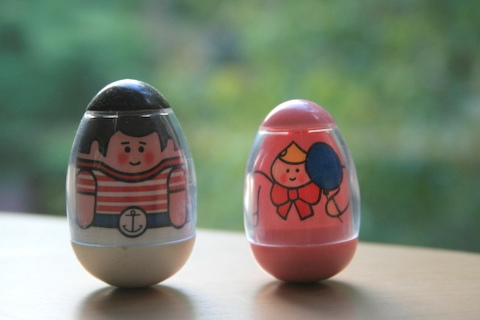
This aversion to patience – and what I have to learn from it – has some bearing on my current state of being. After nine months of baby building, I feel I’ve done my time; another week spent in this bubble bodysuit and Playskool will be redesigning Weeble Wobbles to resemble me! This week, I have been willing the pain of contractions, hoping – with little success – that one will lead to another in quick succession. I imagine myself as my body’s spin class instructor, shouting excitedly into my cavernous womb to get moving and lean in to the pain, to let my techno heartbeat put an end to all this pregnancy madness.

Nevertheless, I’ve learned enough about the discipline of waiting to know that there’s good to come on the other side of patience and that these long, impervious days will fade quickly into joy (and relief) as soon as Baby K makes his or her debut. The downside of this is that his or her arrival will only present a long list of more things about which I must be patient, but that’s a worry for another day. And besides, if I had nothing left to learn or wait on, I probably also wouldn’t have anything to write about, and that would be very sad indeed.